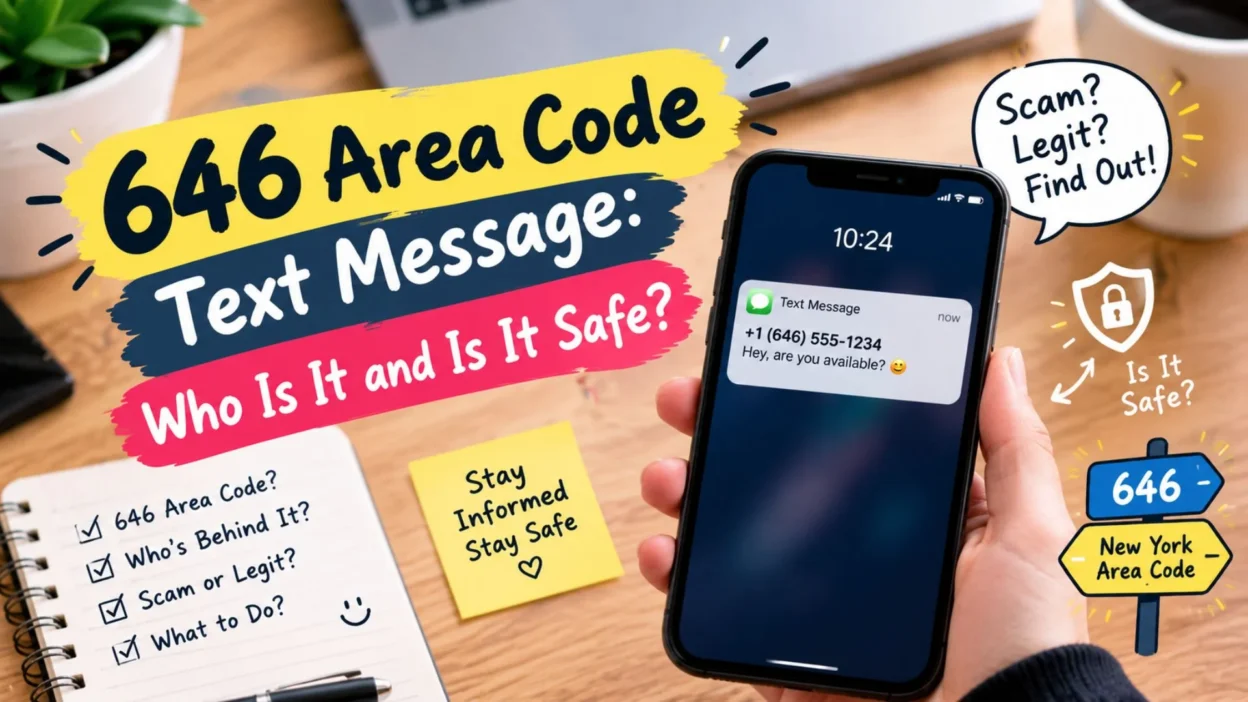
Have you received a text message from a phone number starting with 646? If so, you may be wondering where the number comes from, who is texting you, and whether the message is safe to open.
The 646 area code is associated with New York City, New York, particularly Manhattan. It has been in service since 1999 and shares its geographic area with other codes, including 212, 332, and 917.
However, receiving a text from a 646 number does not automatically mean the sender is in New York. Phone numbers can be used outside their original area, and scammers can sometimes disguise the number shown on your phone.
In this guide, you will learn what a 646 area code text message means, why you might receive one, how to recognize suspicious messages, and what to do if an unknown number contacts you.
What Is the 646 Area Code?
The 646 area code belongs to New York City in the state of New York, United States. It is particularly associated with Manhattan.
The code was introduced in 1999 to provide additional phone numbers for the New York City area. It operates alongside other area codes serving the same region.
Here are some quick facts about area code 646:
- Country: United States
- State: New York
- Main area: Manhattan, New York City
- Time zone: Eastern Time
- Introduced: 1999
- Other associated area codes: 212, 332, and 917
A phone number beginning with 646 may belong to an individual, a business, or an organization using a number associated with this area.
However, the area code alone cannot identify the owner of the number. You need additional information to determine who sent a particular message.
Why Did I Receive a Text Message From a 646 Number?
There are several possible reasons why a 646 number might appear in your messages. The explanation depends on the sender and the content of the text.
1. Someone Is Trying to Contact You
The message may come from someone you know, a new contact, or a person who received your number from someone else.
For example, the sender might write:
“Hey, are you available this afternoon?”
If the message makes sense to you, you may recognize the person from the conversation. If you do not recognize the number, avoid sharing personal information until you know who you are talking to.
2. A Business Is Sending a Message
Some businesses use phone numbers to send appointment reminders, order updates, customer service messages, or verification codes.
For example, you might receive a message about a delivery or an appointment you recently scheduled.
If the message claims to come from a company, verify it through the company’s official website or app rather than relying on the text alone.
3. The Sender Has the Wrong Number
Sometimes, someone simply enters an incorrect phone number. You might receive a message intended for another person.
For example:
“Hi, are we still meeting at 6?”
If you do not know the sender, you do not have to continue the conversation. You can ignore the message if it seems suspicious.
4. It Could Be an Unwanted or Scam Text
Scammers sometimes use unfamiliar numbers to send fake delivery alerts, payment requests, job offers, or messages that encourage you to click a link.
Some begin with a friendly greeting or pretend to have contacted you by mistake. The conversation may later shift toward requesting money or personal information.
The important thing is to judge the message by its content and behavior, not by the 646 area code alone.
Is a 646 Area Code Text Message a Scam?
Not necessarily. The 646 area code is legitimate, but a legitimate area code does not guarantee that a message is trustworthy.
Some messages may be genuine, while others may be unwanted or fraudulent. Phone numbers can also be spoofed, which means the number displayed on your phone may not accurately identify the sender.
Look for these warning signs:
- The sender asks for your password or verification code.
- The message contains an unexpected link asking you to log in.
- You are told to pay an unexpected fee immediately.
- The sender claims you won a prize you never entered to win.
- Someone offers a job but asks you to pay money first.
- The sender pressures you to act quickly.
- A stranger starts a conversation and soon asks for financial help.
The US Federal Trade Commission advises consumers not to click links or share sensitive information in unexpected messages. If a message claims to come from a company, contact that company using verified contact details instead.
Common Types of 646 Area Code Text Messages
Understanding the type of message can help you decide what to do next.
Delivery Notifications
A message might claim that your package could not be delivered or that you need to pay a small fee.
If you are expecting a package, check the tracking information through the delivery company’s official website. Do not use an unfamiliar link from the text.
Bank or Payment Alerts
Some messages claim that your bank account has been locked or that a payment needs approval.
Do not share account details or verification codes. Open your banking app directly or contact your bank using the number printed on your card or listed on its official website.
Job Offers
You might receive an unexpected message offering remote work, easy money, or high pay for very little effort.
Be especially cautious if the sender asks you to deposit money, buy cryptocurrency, or pay a fee before you can begin working.
Friendly or Romantic Messages
Some unfamiliar messages begin with a simple greeting, such as:
“Hi, how have you been?”
The sender might claim to know you or say they have contacted the wrong person. This could be an innocent mistake, but it can also be a way to start a conversation with a stranger.
Never assume that someone is trustworthy simply because their opening message sounds friendly.
How to Check a 646 Number Safely
If you receive a message from an unfamiliar 646 number, follow these steps before responding.
Step 1: Read the Message Carefully
Look for anything unexpected, such as a request for money, a suspicious link, or a demand for personal information.
Do not rush to reply simply because the message sounds urgent.
Step 2: Check Whether You Recognize the Sender
Think about whether you recently contacted a business, scheduled an appointment, or expected a message from someone in New York.
If nothing matches, treat the message cautiously.
Step 3: Verify Any Company Independently
If the sender claims to represent a bank, delivery company, or online service, visit the official website yourself.
Do not use contact details supplied in a suspicious message.
Step 4: Avoid Sharing Personal Information
Never send passwords, banking details, one-time passcodes, or sensitive identity information to an unknown sender.
A genuine-looking message is not proof that the person contacting you is legitimate.
Step 5: Block or Report Suspicious Messages
If the text appears to be spam, use your phone’s built-in reporting options. In the United States, unwanted SMS messages can also be forwarded to 7726 (SPAM) with participating mobile providers.
You can then block the number if you do not want further messages.
Can You Find Out Who Owns a 646 Number?
You may be able to identify a business or person through information they have publicly shared, but an area code alone cannot reveal the owner’s identity.
You can try these methods:
- Search the complete number online to see whether it appears on an official business website.
- Check whether the sender identifies a company in the message.
- Contact the claimed organization through its verified website.
- Use your phone’s caller identification or spam-filtering features.
- Avoid websites that promise guaranteed identification in exchange for sensitive information or payment.
Keep in mind that online number listings can be outdated or incorrect. Even if a search identifies a business associated with a number, it does not necessarily prove that the business sent your message.
Should You Reply to an Unknown 646 Text?
That depends on the message.
If you recognize the sender or can independently verify the reason for the text, replying may be perfectly reasonable.
However, if the message is unexpected and suspicious, it is safer not to engage. Replying can confirm that your number is active, and some scammers use conversations to build trust before making requests.
For example, avoid responding to messages that say:
- “Click here to claim your reward.”
- “Your account will close in ten minutes.”
- “Send me the verification code you just received.”
- “I have a business opportunity that guarantees huge profits.”
If the message seems suspicious, do not click links, download attachments, or provide personal information. Report and delete it instead.
Frequently Asked Questions
Where is the 646 area code located?
The 646 area code is associated with New York City, New York, particularly Manhattan. It shares the area with codes such as 212, 332, and 917.
Why am I getting text messages from a 646 number?
The message could be from a person, business, service, or an incorrect number. It could also be spam or a scam. Check the content carefully before deciding whether to respond.
Is 646 a real US area code?
Yes. 646 is a legitimate US area code associated with New York City. However, a real area code does not prove that an individual text message is genuine.
Does a 646 text message mean the person lives in New York?
No. The area code indicates the geographic area associated with the number, but the person may live elsewhere. Number portability and caller ID spoofing can make the displayed area code an unreliable indicator of the sender’s current location.
Can a 646 number be used for scams?
Yes. Scammers can use numbers associated with legitimate area codes, including 646. Check for suspicious links, urgent payment demands, requests for sensitive information, and other warning signs.
Should I block a 646 number?
If the sender is repeatedly contacting you with unwanted or suspicious messages, blocking the number is a reasonable step. You can also report the message through your phone or mobile provider.
How do I report a scam text in the United States?
You can forward unwanted SMS messages to 7726 (SPAM), where supported, and report fraud to the Federal Trade Commission through its official reporting website. You should also use your phone’s spam-reporting feature when available.
Conclusion
A text message from a 646 area code usually comes from a number associated with New York City, particularly Manhattan. However, the area code does not tell you exactly who sent the message or whether the sender is trustworthy.
If you recognize the sender and the message makes sense, it may be legitimate. If the message is unexpected, asks for money, or includes a suspicious link, take time to verify it before doing anything.
The safest approach is simple: check the message, protect your personal information, and never trust a text based on its area code alone.

Muhammad Shahroz is a passionate writer who creates helpful content about messages and word meanings. He is committed to providing clear, accurate, and easy-to-understand information on TextsMessagez.com.