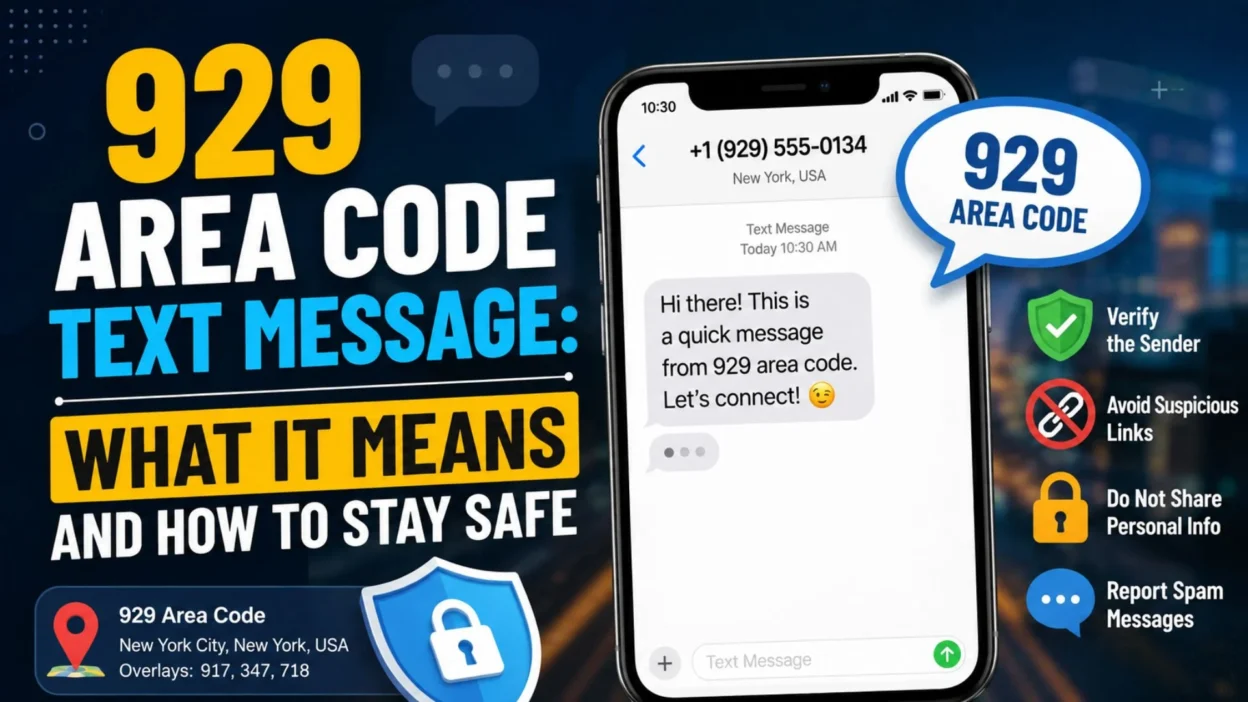
Got a 929 area code text message from a number you do not recognize? You are not alone. Seeing an unfamiliar area code can make anyone pause before replying.
The 929 area code is associated with New York City, but the area code alone does not tell you who sent the message. A real person, business, wrong number, or scammer could be behind it.
The good news is simple: you can check the message without taking unnecessary risks.
What Is the 929 Area Code?
The 929 area code is a New York City area code used alongside other codes in the same region.
- 929 is a geographic area code in New York.
- It serves parts of New York City.
- The area includes Brooklyn.
- It also covers Queens.
- The Bronx is included.
- Staten Island is included.
- It was introduced as an overlay for 718 and 347.
- The 929 overlay became active in 2011.
- It covers the same general geographic area as 718 and 347.
- A 929 number can belong to a mobile phone.
- It can also be associated with other phone services.
- The area code does not identify a specific neighborhood.
- It does not identify the exact person texting you.
- It does not prove that the sender lives in New York.
- Phone numbers can be moved between providers.
- People can keep numbers when changing services.
- Businesses may use 929 numbers too.
- A 929 number is not automatically suspicious.
- The number itself is only one clue.
- The message content matters much more.
NANPA documents 929 as an overlay serving the 718/347 geographic area of New York City.
What Does a 929 Area Code Text Message Mean?
A text from 929 simply means the displayed phone number uses the 929 area code.
- It may be from someone you know.
- It may be from someone you do not know.
- It could be a business message.
- It could be an appointment reminder.
- It could be a delivery notification.
- It could be a wrong-number text.
- It could be advertising.
- It could be a legitimate service alert.
- It could be an automated message.
- It could be a personal message.
- It could be an unwanted text.
- It could be a phishing attempt.
- It could be a scam.
- The area code alone cannot decide which one it is.
- The sender’s name can also be misleading.
- Caller ID information can be spoofed.
- A familiar-looking number is not proof of identity.
- An unfamiliar number is not automatically dangerous.
- Always consider the full message.
- When unsure, verify independently.
The FTC warns that scammers can fake the number or identity displayed with calls and texts, so caller ID should not be treated as proof that a message is genuine.
Where Is the 929 Area Code Located?
The 929 area code belongs to New York City rather than one single small neighborhood.
- Brooklyn uses 929 numbers.
- Queens uses 929 numbers.
- The Bronx uses 929 numbers.
- Staten Island uses 929 numbers.
- It overlaps with 718.
- It overlaps with 347.
- It also shares the broader NYC numbering environment with 917.
- The area code does not give an exact street location.
- It does not reveal someone’s home address.
- It does not prove current physical location.
- A person may live somewhere else now.
- A business may use a number remotely.
- A mobile user can travel anywhere.
- Number portability can change service providers.
- Internet-based phone services can add complexity.
- A New York area code does not guarantee a New York sender.
- A scammer can display a New York number.
- A legitimate sender can also be traveling.
- Geographic assumptions can therefore be misleading.
- Treat the area code as background information, not identity proof.
The official NANPA planning document states that 929 serves the same geographic area covered by the 718/347 overlay: Brooklyn, Queens, the Bronx, and Staten Island.
Why Did I Get a Text From a 929 Number?
There are several possible reasons you received the message.
- Someone may have the wrong number.
- A friend may be using a new number.
- A company may be contacting you.
- A delivery service may send an alert.
- An appointment system may send a reminder.
- A website may send a verification message.
- A business may send a promotional text.
- Someone may have entered your number by mistake.
- A number may have been recycled.
- A message could be automated.
- A marketing list may contain your number.
- A spammer may have your number.
- A scammer may be testing whether you respond.
- A phishing campaign may be targeting many numbers.
- The sender may pretend to be someone familiar.
- The message may use a fake company name.
- The displayed number may be spoofed.
- The text may be harmless.
- The safest answer depends on the message itself.
A 929 number is therefore not enough to label a text as legitimate or fraudulent.
Is a 929 Text Message a Scam?
Not necessarily. A 929 text message can be legitimate or unwanted.
- 929 is a normal New York area code.
- The area code itself is not a scam.
- Legitimate people use 929 numbers.
- Legitimate businesses can use 929 numbers.
- Scammers can also use 929 numbers.
- Spoofing can make a number appear genuine.
- Unexpected messages deserve extra attention.
- Links deserve special caution.
- Requests for money are a major warning sign.
- Requests for passwords are suspicious.
- Requests for financial details require caution.
- Urgent threats can be a red flag.
- Fake prizes are common scam themes.
- Fake delivery notices can be phishing attempts.
- Fake bank alerts can be dangerous.
- Wrong-number conversations can sometimes lead into scams.
- Unexpected job offers can be fraudulent.
- Fake loan messages can request sensitive information.
- You should verify important claims independently.
- Never judge a message only by its area code.
The FTC specifically advises consumers not to click unexpected text-message links or respond to suspicious messages.
Common Signs of a Suspicious 929 Text
The wording often tells you more than the number.
- “Your account has been locked.”
- “Your package cannot be delivered.”
- “You won a prize.”
- “Claim your reward now.”
- “Your payment failed.”
- “Confirm your bank account.”
- “Verify your identity immediately.”
- “You have an unpaid toll.”
- “Click here to avoid a fee.”
- “You have been selected for a job.”
- “Reply YES to continue.”
- “Send your verification code.”
- “Your refund is waiting.”
- “Your account will close today.”
- “Contact this number immediately.”
- “Pay now to avoid penalties.”
- “Your card has suspicious activity.”
- “You have an urgent notification.”
- “Your loan was approved.”
- “Your delivery needs an update.”
- “Click the link to fix the problem.”
These themes do not prove that a message is fraudulent, but they are reasons to stop and verify before taking action. The FTC has specifically warned about fake bank alerts, delivery notices, unpaid-toll messages, job offers, loan texts, and other unexpected messages.
Should You Reply to a 929 Text?
If you do not recognize the sender, pausing is usually safer than replying immediately.
- Do not feel pressured to answer quickly.
- Read the entire message first.
- Check whether you expected the contact.
- Look for unusual requests.
- Avoid sharing private information.
- Avoid sending passwords.
- Avoid sending financial information.
- Avoid sharing verification codes.
- Do not click unexpected links.
- Do not call an unfamiliar number from the message.
- Do not send money because of a text.
- Do not let urgency control your decision.
- Verify the sender independently.
- Use an official website if needed.
- Use a known phone number.
- Contact the company directly.
- Block the number if it is unwanted.
- Report suspicious messages.
- Delete the message after reporting when appropriate.
- When in doubt, stop before responding.
The FTC recommends ignoring unexpected texts and checking through contact information you already know is genuine.
What If the 929 Message Contains a Link?
A link can turn a simple text into a bigger problem.
- Do not click immediately.
- Check why the link was sent.
- Ask whether you expected the message.
- Look at the surrounding wording.
- Be careful with shortened links.
- Be careful with strange domains.
- Be careful with spelling mistakes.
- Do not enter passwords through an unexpected link.
- Do not enter card details.
- Do not enter bank information.
- Do not download unknown files.
- Do not install an app from a suspicious message.
- Do not trust a familiar logo alone.
- Open the official website separately.
- Use your existing account or app.
- Check your order directly.
- Check your bank account through its normal app.
- Verify delivery information independently.
- Report the message if it appears fraudulent.
The FTC says unexpected text links can lead to fake websites designed to collect personal or financial information.
How to Check a 929 Text Message Safely
You can investigate without interacting with the sender.
- Start with the message content.
- Ask whether you recognize the situation.
- Check your recent purchases.
- Check your existing appointments.
- Check your delivery orders.
- Check your bank’s official app.
- Check your account through its normal website.
- Search for the company’s official contact information.
- Do not use contact details supplied only by the text.
- Compare the message with expected notifications.
- Look for pressure or threats.
- Look for unusual payment requests.
- Look for requests for private data.
- Check whether the message contains a suspicious link.
- Avoid calling unknown numbers from the text.
- Search the company independently.
- Contact someone you trust if unsure.
- Take screenshots when documenting suspicious texts.
- Report the message if appropriate.
- Delete it after you finish documenting it.
The basic rule is easy: verify the claim somewhere other than the message itself.
929 Wrong Number Text Messages
Wrong-number texts can look innocent. Sometimes they really are innocent.
- Someone may simply type one wrong digit.
- The sender may apologize.
- You may receive a message meant for another person.
- The conversation may end quickly.
- A harmless wrong number does not require a long conversation.
- You do not need to reveal your identity.
- You do not need to share your location.
- You do not need to explain personal details.
- Be careful if the sender keeps chatting.
- Be cautious if the conversation becomes financial.
- Be cautious if investment topics appear.
- Be cautious if cryptocurrency appears unexpectedly.
- Be cautious if romance develops very quickly.
- Be cautious if a job offer appears.
- Be cautious if someone asks you to move to another app.
- Be cautious if links suddenly appear.
- Do not send money to a stranger.
- Do not share account credentials.
- You can simply ignore or block the number.
- You can report the message if it becomes suspicious.
The FTC has warned that “wrong number” texts can be used as an opening for scams, so an innocent-looking start does not guarantee a safe conversation.
929 Texts About Jobs
Unexpected job texts deserve careful checking.
- Did you actually apply for the job?
- Do you recognize the company?
- Is the recruiter using an official contact?
- Does the company have a real website?
- Does the job exist on the company’s careers page?
- Is the message asking for money?
- Is it asking for banking information?
- Is it asking for identity documents immediately?
- Is it asking you to click an unfamiliar link?
- Is the pay promise unusually attractive?
- Is there pressure to act today?
- Is the sender avoiding normal hiring steps?
- Is the company name misspelled?
- Is the contact using a personal number?
- Can you verify the recruiter independently?
- Do not send money to get a job.
- Do not share sensitive information too early.
- Do not trust a job simply because the company name looks familiar.
- Research the employer separately.
- Delete and report suspicious job texts.
The FTC says unexpected job texts that ask recipients to respond, click links, or provide personal or financial information can be job scams.
929 Texts About Deliveries
Package messages are another common theme in unwanted texts.
- Did you actually order something?
- Check your shopping account directly.
- Use the retailer’s official app.
- Check the tracking page yourself.
- Do not rely on the text’s link.
- Be careful with delivery-fee requests.
- Be careful with address-update requests.
- Be careful with payment requests.
- Check the sender’s details.
- Look for strange web addresses.
- Do not provide card information through the message.
- Do not provide identity information.
- Do not download an attachment.
- Do not panic over a “final warning.”
- Verify with the retailer.
- Verify with the carrier through its official website.
- Screenshot the message if necessary.
- Report suspicious texts.
- Block repeat senders.
- Delete the message after reporting it.
The FTC has warned about fake package and delivery texts that direct people to look-alike websites.
929 Texts Pretending to Be Your Bank
Bank-related texts require extra caution.
- Do not click a bank link from an unexpected text.
- Do not share your password.
- Do not share a one-time code.
- Do not provide your card number.
- Do not provide your PIN.
- Do not provide security answers.
- Open your banking app directly.
- Check recent transactions there.
- Use the official bank website.
- Call the number printed on your card.
- Do not use a number supplied by the suspicious text.
- Do not trust a caller ID name alone.
- Watch for urgent language.
- Watch for fake fraud alerts.
- Watch for fake payment notices.
- Watch for account-lock threats.
- Take screenshots when useful.
- Report the message to your bank through an official channel.
- Report the scam when appropriate.
- Block the sender after handling the report.
The FTC has warned that scammers can use fake fraud alerts to make people respond to a text or call a number controlled by the scammer.
Can a 929 Number Be Spoofed?
Yes. A displayed phone number is not always proof of the real sender.
- Spoofing can make a number appear different.
- A scammer may display a local-looking number.
- The displayed area code may be genuine.
- The sender may still be somewhere else.
- A familiar-looking number can be deceptive.
- A business name can also be misleading.
- Caller ID is useful but not perfect.
- Text messages can also involve spoofing.
- The FCC has rules addressing malicious spoofing.
- Number appearance should not be your only check.
- Message content matters.
- Unexpected requests matter.
- Links matter.
- Payment requests matter.
- Identity requests matter.
- Urgency matters.
- Independent verification is stronger.
- Official apps are safer for account checks.
- Known phone numbers are safer for verification.
- When something feels unusual, pause first.
The FCC has addressed spoofing involving text messages, while the FTC warns that phone numbers and caller ID information can be faked.
What Should You Do With an Unwanted 929 Text?
A few simple steps can reduce future trouble.
- Do not reply.
- Do not click links.
- Do not provide personal information.
- Do not provide financial information.
- Use your phone’s spam-reporting feature.
- Block the sender.
- Forward unwanted texts to 7726 when supported.
- Report scams to the FTC.
- Keep screenshots if documentation is useful.
- Contact your provider if the messages continue.
- Check your phone’s spam filters.
- Enable unknown-sender filtering when available.
- Review blocked contacts.
- Avoid engaging with suspicious senders.
- Warn family members about active scams.
- Tell friends about common scam patterns.
- Keep your phone software updated.
- Use trusted security features.
- Monitor important accounts after a suspicious interaction.
- Take action quickly if you shared sensitive information.
The FTC recommends forwarding unwanted texts to 7726 (SPAM), using your messaging app’s reporting tools, and reporting scams through ReportFraud.ftc.gov.
How to Block a 929 Number
Blocking a number is simple on most modern phones.
- Open your Messages app.
- Find the unwanted conversation.
- Open the message thread.
- Look for the sender information.
- Choose the block option.
- Confirm the block.
- Use “Report Spam” if your phone provides it.
- Check your blocked-number settings.
- Turn on spam filtering if available.
- Filter unknown senders when useful.
- Review your carrier’s blocking options.
- Use trusted call-blocking tools when needed.
- Avoid downloading random blocking apps.
- Check app permissions before installing anything.
- Keep your messaging app updated.
- Continue monitoring for similar messages.
- Block new numbers if the campaign continues.
- Report serious scams.
- Do not reply just to tell the sender to stop.
The FTC notes that phones, wireless providers, and some call-blocking apps may offer tools for filtering or blocking unwanted texts.
What If You Already Replied?
Do not panic. A reply does not automatically mean your accounts are compromised.
- Stop the conversation.
- Do not send more information.
- Do not click later links.
- Do not continue chatting.
- Block the sender.
- Report the message.
- Check whether you shared personal details.
- Check whether you shared financial information.
- Check whether you shared a password.
- Check whether you shared a verification code.
- Change a compromised password promptly.
- Use a strong unique password.
- Turn on multi-factor authentication where available.
- Contact your bank if financial details were exposed.
- Monitor relevant accounts.
- Watch for unusual activity.
- Save screenshots of the conversation.
- Report identity theft if applicable.
- Follow official recovery guidance.
- Be cautious of anyone offering paid “recovery” help.
The right next step depends on what information, if any, was shared.
What If You Clicked a 929 Text Link?
Clicking a link does not always mean something bad happened. What you do next matters.
- Close the suspicious page.
- Do not enter additional information.
- Do not download unknown files.
- Do not install unfamiliar apps.
- Do not give the site payment details.
- If you entered a password, change it.
- Use the official website instead.
- Review the account connected to that password.
- Turn on multi-factor authentication.
- Watch for unusual account activity.
- Contact your bank if financial information was entered.
- Follow your bank’s official security guidance.
- Update your device.
- Keep security software active.
- Save the suspicious message.
- Report the scam if appropriate.
- Check your browser’s downloads.
- Remove anything suspicious you knowingly installed.
- Ask a trusted professional for help if needed.
- Stay alert for follow-up messages.
The FTC warns that suspicious text links can lead to spoofed websites designed to collect sensitive information.
How to Tell a Real Message From a Suspicious One
There is no magic “929 detector.” Instead, use several clues together.
- Were you expecting the message?
- Do you know the sender?
- Does the situation make sense?
- Is the company name correct?
- Does the message contain a strange link?
- Does it request money?
- Does it request private information?
- Does it create unnecessary urgency?
- Does it threaten immediate consequences?
- Does it promise an unrealistic reward?
- Does it ask for a verification code?
- Does it ask you to move to another platform?
- Can you verify the claim independently?
- Does the official company account show the same information?
- Can you find the company’s official website yourself?
- Does the sender avoid normal communication channels?
- Are there unusual spelling or grammar errors?
- Is the message completely unexpected?
- Does the sender keep pushing after you hesitate?
- If several red flags appear, stop and verify.
The FTC recommends resisting pressure to act immediately and verifying companies through contact information you know is genuine.
Common 929 Text Message Examples
These examples show why context matters.
- “Hey, is this Sarah?”
- “Are you available today?”
- “Your appointment is tomorrow.”
- “Your package is arriving.”
- “Please confirm your delivery.”
- “Your bank detected suspicious activity.”
- “Your payment could not be processed.”
- “You won a gift card.”
- “Claim your reward.”
- “We have a job opportunity.”
- “Your loan application is ready.”
- “Please verify your account.”
- “Your subscription is expiring.”
- “Your account needs attention.”
- “Reply YES to continue.”
- “Click here for details.”
- “You have an unpaid toll.”
- “Your refund is waiting.”
- “We need additional information.”
- “Contact us immediately.”
Some of these could appear in legitimate communications. Others can be used in scams. The important question is not simply “Is this from 929?” but “Can I independently verify this message?”
Quick 929 Area Code Text Message Safety Checklist
Save this checklist for the next unexpected message.
- Recognize the sender.
- Read the entire message.
- Check whether you expected it.
- Do not rush.
- Do not click unknown links.
- Do not share passwords.
- Do not share verification codes.
- Do not share financial information.
- Do not send money.
- Verify through an official channel.
- Use your bank’s official app.
- Use a retailer’s official website.
- Check delivery information independently.
- Search the company separately.
- Block unwanted numbers.
- Report spam messages.
- Forward unwanted texts to 7726 when available.
- Report scams to the FTC.
- Save evidence when needed.
- Tell someone you trust if you are unsure.
FAQs
Is the 929 area code a scam?
No. 929 is a legitimate New York City area code. A text from a 929 number can be legitimate, unwanted, or fraudulent. The area code itself does not determine whether a message is safe.
What city uses the 929 area code?
The 929 area code serves parts of New York City, including Brooklyn, Queens, the Bronx, and Staten Island. It overlays the 718 and 347 area codes in that geographic area.
Should I reply to an unknown 929 text?
If you do not recognize the sender, avoid replying until you can verify the message. In particular, do not respond to unexpected messages asking for money, personal information, passwords, or verification codes.
Can scammers use a 929 number?
Yes. Phone numbers and sender information can be spoofed. That means a 929 number appearing on your screen does not prove that the person actually controls a New York 929 number.
How do I report a suspicious 929 text?
You can use your phone’s report-spam feature, forward unwanted texts to 7726 (SPAM) when supported, and report scams to the FTC through ReportFraud.ftc.gov. The FCC also accepts complaints about unwanted calls and texts.
Conclusion
A 929 area code text message is not automatically a scam. The 929 area code is a legitimate New York City area code serving Brooklyn, Queens, the Bronx, and Staten Island.
Still, an unexpected message deserves a careful look. Do not click suspicious links, send money, or share sensitive information before verifying the sender independently.
If this guide helped you understand a strange 929 text, share it with someone who might need it, save it for later, or leave a comment about the type of message you received.

Muhammad Shahroz is a passionate writer who creates helpful content about messages and word meanings. He is committed to providing clear, accurate, and easy-to-understand information on TextsMessagez.com.