
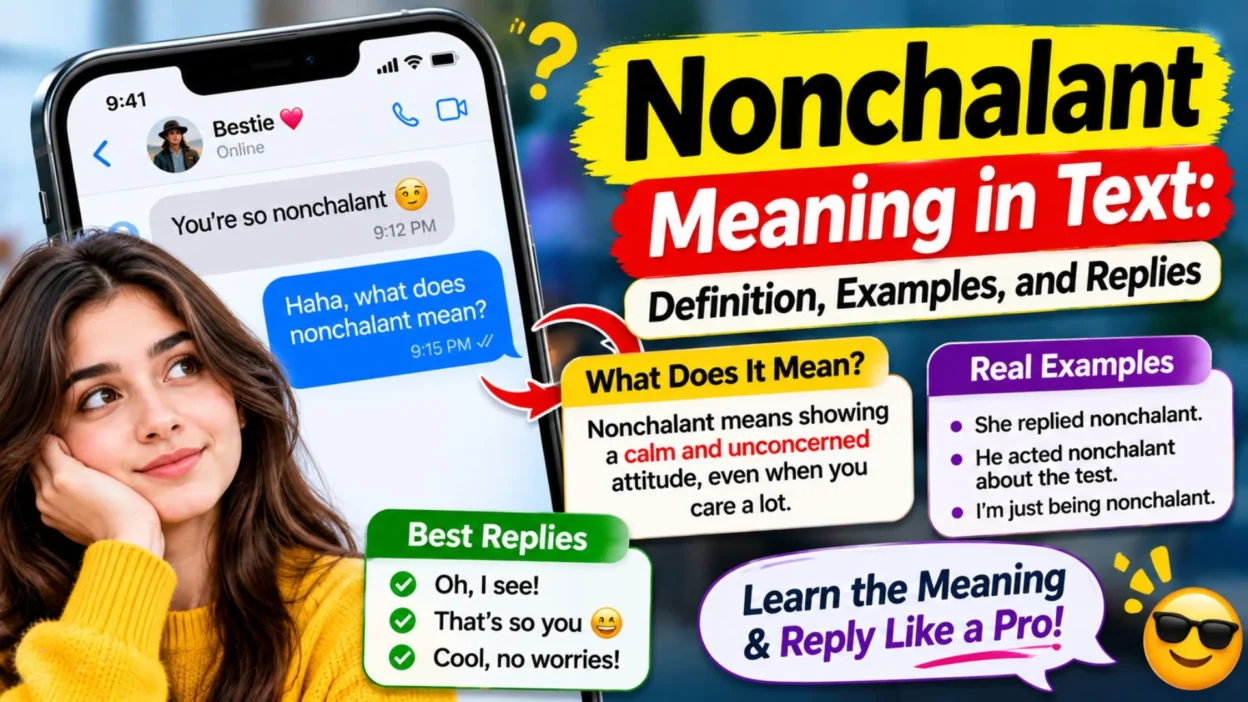
Have you ever received a message that sounded calm, casual, or completely uninterested? Someone might describe that person as “nonchalant.” This word is common in everyday conversations, social media posts, and text messages.
Nonchalant means appearing calm, relaxed, or unconcerned about something. In texting, it often describes someone who does not show much emotion or excitement in their messages.
For example, if someone receives exciting news but responds with “Oh, that’s cool,” they might seem nonchalant. Their reaction appears relaxed, even when other people might expect more excitement.
In this guide, you’ll learn the nonchalant meaning in text, how people use it, real-life examples, and ways to respond when someone calls you nonchalant.
What Does Nonchalant Mean in Text?
The word nonchalant describes a person who seems relaxed, casual, or unconcerned about a particular situation.
In text messages, it usually refers to someone who replies without showing strong emotions. Their messages may sound simple, calm, or slightly uninterested.
For example:
However, a short reply does not always mean someone is uninterested. They might simply be busy, tired, or naturally less expressive.
What Does Nonchalant Mean in Slang?
In modern slang, nonchalant often describes someone who acts unbothered, confident, or emotionally unaffected.
People sometimes use this word to describe someone who does not chase attention or react dramatically.
For example:
- “He’s so nonchalant about everything.”
- “I tried to make her jealous, but she stayed nonchalant.”
- “That was the most nonchalant reply ever.”
- “I want to be more nonchalant and stop overthinking.”
On social media, the word can also describe a relaxed personality or someone who does not appear easily impressed.
10 Examples of Nonchalant in Text Messages
The easiest way to understand this word is through everyday texting situations.
Here are 10 examples:
- “Okay, no problem.” – A calm response without much emotion.
- “That’s cool.” – A casual reaction to something.
- “Do whatever you want.” – A response that may sound unconcerned.
- “It’s not a big deal.” – Showing that something does not seem important.
- “I’m fine either way.” – Expressing that both options are acceptable.
- “Oh, really?” – A relaxed reaction to surprising news.
- “No worries.” – Showing that you are not concerned.
- “I’ll see what happens.” – Taking a relaxed approach to a situation.
- “It’s all good.” – Suggesting that everything is okay.
- “Whatever works for you.” – Showing flexibility without strong preference.
These messages can sound nonchalant depending on the situation and the person’s usual texting style.
What Does It Mean When Someone Is Nonchalant?
When someone is described as nonchalant, it usually means they appear calm and do not show much concern.
Their behavior may suggest that they are not easily bothered by everyday situations.
For example, imagine your friend is waiting for an important result. While everyone else feels nervous, your friend simply says, “Let’s see what happens.”
That relaxed attitude may be described as nonchalant.
However, being nonchalant does not always mean someone has no feelings. Some people simply prefer not to express their emotions openly.
Is Being Nonchalant Good or Bad?
Being nonchalant can be positive or negative. It depends on the situation and how someone expresses their feelings.
Positive Side of Being Nonchalant
A nonchalant attitude can help people stay calm during stressful situations.
Some possible benefits include:
- Staying relaxed under pressure.
- Avoiding unnecessary arguments.
- Not overreacting to small problems.
- Feeling comfortable with yourself.
- Making decisions without too much stress.
For example, someone who remains calm after receiving criticism may handle the situation more thoughtfully.
Negative Side of Being Nonchalant
Sometimes, acting too nonchalant can make others feel ignored or unimportant.
Here are a few possible disadvantages:
- People may think you are uninterested.
- Your replies may sound cold.
- Friends might misunderstand your intentions.
- You may appear emotionally distant.
- Important conversations may feel one-sided.
The key is to stay calm without making other people feel that their feelings do not matter.
Nonchalant Meaning in Relationships
In relationships, nonchalant often describes someone who does not openly express excitement, affection, or concern.
For example, imagine one person sends a sweet message while the other replies with only “Okay.”
The second person might appear nonchalant because their response does not match the emotional tone of the conversation.
However, this does not automatically mean they have lost interest.
Some people express affection through actions rather than words. Others may simply have a naturally calm texting style.
If someone’s behavior makes you uncomfortable, having an honest conversation is better than making assumptions.
Nonchalant Meaning on Social Media
On platforms like TikTok, Instagram, and Snapchat, people often use nonchalant to describe a calm or unbothered attitude.
You might see captions such as:
- “Trying to stay nonchalant.”
- “The most nonchalant person in the room.”
- “Acting nonchalant when I actually care.”
- “Nonchalant energy only.”
- “Too nonchalant to argue.”
These expressions usually describe someone who wants to appear relaxed, confident, or unaffected by a situation.
Sometimes, people use the word humorously when their real feelings are completely different from their outward reaction.
How to Reply When Someone Calls You Nonchalant
If someone calls you nonchalant, your response depends on whether they are joking, complimenting you, or expressing frustration.
Here are some natural replies you can use.
1. Casual Replies
- “I just like keeping things simple.”
- “That’s just how I am.”
- “I don’t stress over everything.”
- “I prefer staying calm.”
- “I guess that’s my personality.”
2. Funny Replies
- “I’m just saving my energy!”
- “Drama isn’t on my schedule.”
- “My emotions are on airplane mode.”
- “I’m calm, not confused!”
- “That’s my natural setting.”
3. Confident Replies
- “I know what deserves my energy.”
- “Staying calm is my choice.”
- “I don’t need to react to everything.”
- “Peace matters more than drama.”
- “I prefer thinking before reacting.”
4. Sweet Replies
- “I care, even if I don’t always show it.”
- “I’m calm, but that doesn’t mean I’m ignoring you.”
- “Sometimes I just don’t know what to say.”
- “I may seem quiet, but I do listen.”
- “Your feelings still matter to me.”
Difference Between Nonchalant and Unbothered
Nonchalant and unbothered have similar meanings, but they are not exactly the same.
| Word | Meaning | Example |
|---|---|---|
| Nonchalant | Appearing calm and unconcerned | “She gave a nonchalant reply.” |
| Unbothered | Not feeling disturbed or affected | “He remained unbothered by the criticism.” |
The main difference is that nonchalant often describes someone’s outward behavior, while unbothered focuses more on how affected they feel.
Difference Between Nonchalant and Indifferent
These words can also sound similar, but they express different ideas.
| Word | Meaning | Example |
|---|---|---|
| Nonchalant | Calm or casually unconcerned | “He acted nonchalant about the news.” |
| Indifferent | Having little or no interest or preference | “She was indifferent to the decision.” |
Someone can act nonchalant while still caring deeply. However, an indifferent person may genuinely have little interest in the matter.
Synonyms for Nonchalant
If you want to describe someone who seems relaxed or unconcerned, these words may help.
- Calm: Not nervous or upset.
- Relaxed: Free from tension or worry.
- Unbothered: Not affected by something.
- Casual: Informal and relaxed.
- Carefree: Not worried about problems.
- Composed: Calm and in control of emotions.
- Unconcerned: Not showing worry or interest.
- Easygoing: Relaxed and comfortable with different situations.
- Cool: Calm and confident.
- Detached: Emotionally distant or not strongly involved.
Each synonym has a slightly different meaning, so choose the word that best describes the situation.
Frequently Asked Questions About Nonchalant Meaning in Text
1. What does nonchalant mean in text messages?
Nonchalant means appearing calm, relaxed, or unconcerned in a conversation. It often describes someone who gives casual replies without showing strong emotions.
2. Does nonchalant mean you don’t care?
Not necessarily. Someone can appear nonchalant while still caring about a person or situation. The word usually describes how they act rather than what they truly feel.
3. Is nonchalant a compliment?
It can be a compliment when someone uses it to describe a calm, confident, and relaxed personality. However, it may sound negative if they mean that someone seems uninterested or emotionally distant.
4. What is a nonchalant reply?
A nonchalant reply is a calm or casual response that does not show much excitement or concern.
For example, replying “That’s fine” to a situation that might normally receive a stronger reaction.
5. What does nonchalant mean in a relationship?
In a relationship, nonchalant may describe someone who does not openly show affection, excitement, or concern. However, their calm behavior does not necessarily mean they have lost interest.
6. Is nonchalant the same as unbothered?
They are similar but slightly different. Nonchalant describes an outwardly relaxed attitude, while unbothered means something does not disturb or affect a person.
7. How can I act more nonchalant?
Try to stay calm, avoid reacting immediately, and focus on what you can control. However, you should still communicate honestly and show care when it matters.
8. What is the opposite of nonchalant?
Some opposites include anxious, nervous, concerned, emotional, and bothered. These words describe people who show more worry or emotional reaction.
Final Thoughts
Understanding the nonchalant meaning in text can make online conversations easier to interpret. The word describes someone who appears calm, relaxed, or unconcerned about a situation.
You may see it in text messages, relationships, social media captions, and everyday discussions. Sometimes it describes confidence and emotional control, while other times it suggests a lack of interest.
Remember, a nonchalant reply does not always mean someone does not care. Consider the person’s behavior and the full conversation before making assumptions.

Muhammad Shahroz is a passionate writer who creates helpful content about messages and word meanings. He is committed to providing clear, accurate, and easy-to-understand information on TextsMessagez.com.