Have you ever received a text message that says “SMH” and wondered what it means? This abbreviation appears in text messages, social media comments, and online conversations. If you are unfamiliar with texting slang, it can be confusing at first.
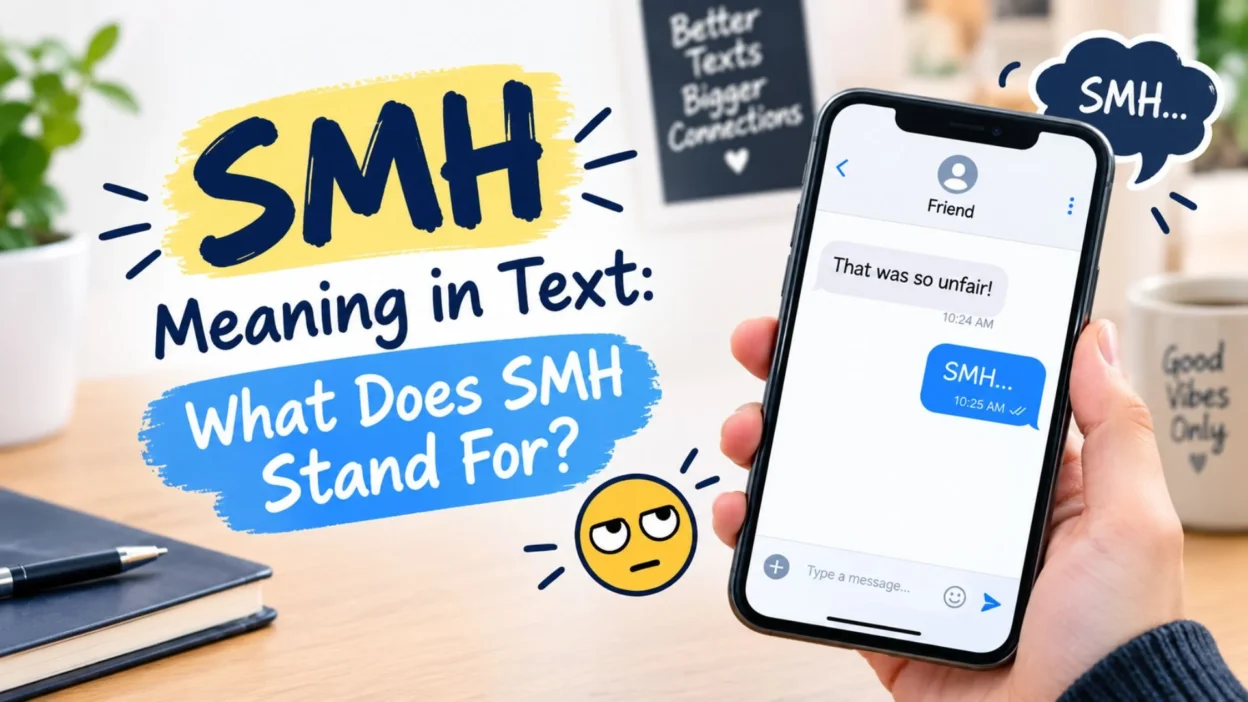
SMH stands for “shaking my head.” People use it to express disappointment, disbelief, frustration, or disapproval. It is a quick way to react when something seems silly, surprising, or difficult to believe.
For example, if your friend forgets their homework for the third time, you might reply, “SMH, you forgot it again!”
In this guide, you will learn the meaning of SMH in text messages, how people use it, real-life chat examples, and the best ways to reply. You will also discover similar abbreviations that can help you understand online conversations more easily.
What Does SMH Mean in Text?
SMH means “shaking my head.” It describes the gesture of moving your head from side to side or up and down to show a reaction. In texting, however, people usually use it as an expression rather than describing a physical action.
Someone might send SMH when they feel disappointed by a mistake, surprised by a strange situation, or frustrated with another person’s behavior.
For example:
Friend 1: I left my phone at home again.
Friend 2: SMH, how do you keep forgetting it?
In this conversation, SMH expresses mild frustration and disbelief. The second person cannot believe their friend has forgotten their phone again.
Here are the most common feelings associated with SMH:
- Disappointment: Reacting to a poor decision or mistake.
- Disbelief: Showing that something is hard to believe.
- Frustration: Responding to an annoying situation.
- Disapproval: Showing that you do not agree with someone’s actions.
- Amusement: Reacting to something silly or ridiculous.
The exact meaning depends on the conversation. SMH can be playful among friends, but it may sound critical in a serious discussion.
What Does SMH Stand For?
The full form of SMH is “shaking my head.” It is a common internet abbreviation used in informal communication.
People often shake their heads to express disappointment, disagreement, or disbelief. SMH brings that familiar reaction into written conversations.
For example:
- “SMH, he missed the bus again.”
- “You paid that much for a coffee? SMH.”
- “SMH, I cannot believe this happened.”
- “She forgot her own birthday. SMH!”
In each example, the abbreviation communicates a reaction without requiring a long explanation.
SMH is generally used in lowercase or uppercase. Both “SMH” and “smh” usually have the same meaning.
Examples of SMH in Text Messages
The best way to understand SMH is to see how people use it in everyday conversations. Here are some simple examples.
Text MessageMeaningSMH, you forgot again.I am disappointed that you forgot again.He failed to read the instructions, SMH.I cannot believe he did not read them.SMH, what a silly mistake.That mistake is frustrating or surprising.You lost your keys again? SMH.I am surprised you lost them again.SMH, people can be so rude.I disapprove of people’s rude behavior.I stayed up all night for nothing. SMH.I am frustrated about what happened.SMH, I should have checked first.I regret not checking beforehand.They cancelled the plan at the last minute. SMH.I am disappointed about the cancellation.SMH, my laptop froze again.I am frustrated that the laptop stopped working.You ate my leftovers? SMH!I cannot believe you ate my food.
These examples show that SMH is flexible. It can describe frustration with technology, disappointment about plans, or disbelief at someone’s actions.
How Is SMH Used in Different Situations?
SMH can communicate several emotions. Understanding the situation helps you decide what the sender really means.
1. SMH to Show Disappointment
People use SMH when someone makes a mistake or does something disappointing.
Example:
Alex: I forgot to submit my assignment.
Sam: SMH, you had the whole week to finish it.
Here, Sam expresses disappointment because Alex had plenty of time to complete the assignment.
SMH can also be used when someone feels disappointed in their own actions.
Example:
Mia: I left my umbrella at home, and now it is raining.
Lily: SMH, I should have reminded you!
The abbreviation makes the reaction sound casual and conversational.
2. SMH to Express Disbelief
Sometimes, people use SMH when something seems unbelievable.
Example:
Friend 1: He watched the entire movie and still asked what happened.
Friend 2: SMH, seriously?
The second person is surprised by the situation. SMH expresses that reaction quickly.
3. SMH to Show Frustration
SMH is also common when people deal with annoying situations.
Example:
Person A: My internet stopped working right before my meeting.
Person B: SMH, that is the worst timing.
Here, SMH communicates frustration about an inconvenient problem.
4. SMH as a Joke
Friends sometimes use SMH in a playful way when someone does something silly.
Example:
Jake: I spent ten minutes looking for my glasses, but they were on my head.
Ryan: SMH 😂
Ryan is not necessarily angry. He finds the situation funny and is teasing his friend.
An emoji can help make the playful tone clearer.
5. SMH on Social Media
SMH also appears in comments, posts, and discussions on social media platforms. People may use it to react to surprising news, a disappointing decision, or an unbelievable video.
For example:
“SMH, why would anyone do that?”
The comment expresses disapproval or disbelief. However, the tone depends on the content and the relationship between the people involved.
How to Reply When Someone Sends SMH
Your response depends on why the other person used SMH. They may be joking, expressing frustration, or showing disappointment.
Here are some natural ways to reply.
If They Are Joking
If a friend sends SMH after you do something silly, you can keep the conversation light.
Example:
Friend: You put salt in your coffee? SMH 😂
You: I was half asleep!
You could also reply with “LOL, my bad!” or “I know, that was silly.”
If They Are Disappointed
If someone uses SMH because you made a mistake, acknowledge it rather than getting defensive.
Example:
Friend: SMH, you forgot our meeting.
You: Sorry, I completely lost track of time.
A simple apology can help clear up the situation.
If They Are Frustrated
When someone is frustrated about something outside their control, show understanding.
Example:
Friend: My phone died before I could save my work. SMH.
You: That is so frustrating. I hope you can recover it.
This response shows empathy without making the conversation more stressful.
If You Do Not Understand Their Message
If you cannot tell what the sender means, it is fine to ask.
You could say:
- “What happened?”
- “Why the SMH?”
- “Are you upset about something?”
- “Wait, what did I miss?”
These replies help you understand the situation before making assumptions.
Is SMH Rude?
SMH is not automatically rude. Its tone depends on the situation, the words around it, and the relationship between the people chatting.
Among friends, SMH may be a harmless joke. In a serious conversation, however, it can sound dismissive or judgmental.
For example:
Friendly use: “SMH 😂 You really forgot your lunch again?”
This sounds playful because the emoji and familiar relationship soften the message.
Critical use: “SMH. You should have known better.”
This sounds more judgmental because the sender directly criticizes someone’s behavior.
If you are messaging a teacher, employer, client, or someone you do not know well, it is usually better to explain your reaction in complete words. This avoids misunderstandings and keeps your message respectful.
Difference Between SMH, SMDH, and Facepalm
SMH has a few related expressions that people may use online. Although their meanings are similar, there are small differences.
TermFull Form or MeaningCommon UseSMHShaking my headDisappointment, disbelief, or frustrationSMDHShaking my damn headStronger frustration or disbeliefFacepalmCovering your face with your handEmbarrassment, frustration, or disbeliefLOLLaughing out loudAmusement or laughterWTFWhat the heck or a stronger profane phraseShock, confusion, or disbeliefIDKI don’t knowUncertainty or lack of knowledgeTBHTo be honestIntroducing an honest opinionNGLNot gonna lieEmphasizing a candid statement
Note: SMDH is stronger than SMH because it includes an intensifier. Some people may find it more expressive or less polite.
A facepalm is not necessarily an abbreviation. It describes a gesture and is also used as an online reaction.
Is SMH Still Used in Texting?
SMH remains recognizable in many online conversations, text messages, and social media comments. People use it because it is short and communicates a familiar reaction.
You may see it in group chats, comments on videos, discussions about current events, or messages between friends.
However, not everyone uses texting slang in the same way. Some people prefer complete sentences, while others regularly use abbreviations.
You do not need to use SMH in every conversation. Use it when it fits your tone and the situation.
Common Mistakes to Avoid When Using SMH
SMH is easy to understand once you know its full form, but a few mistakes can lead to confusion.
1. Using SMH in Every Situation
SMH is useful for expressing disbelief or disappointment. It is not always the best response to a serious or sensitive message.
If someone shares bad news, a supportive reply is usually more appropriate than SMH.
2. Assuming the Sender Is Angry
A message containing SMH does not always mean the sender is angry with you. They might be joking, reacting to an event, or expressing frustration with something else.
Read the full conversation before deciding how to respond.
3. Using SMH in Formal Emails
SMH is informal internet slang. Avoid using it in job applications, business emails, academic writing, and other formal communication.
Instead of writing “SMH, the meeting was cancelled,” you could write, “I am disappointed that the meeting was cancelled.”
4. Forgetting That Tone Matters
A short message can sound different depending on punctuation and emojis.
For example, “SMH 😂” may sound playful, while “SMH.” may feel more serious or disapproving. Still, neither version has a fixed emotional meaning in every conversation.
Frequently Asked Questions About SMH Meaning in Text
1. What does SMH mean in texting?
SMH stands for “shaking my head.” People use it to express disappointment, disbelief, frustration, or disapproval in text messages and online conversations.
2. What does SMH mean from a girl?
If a girl sends SMH, she is usually expressing a reaction such as disbelief, disappointment, or playful frustration. The meaning depends on the message and the context. It does not automatically mean she is angry or interested romantically.
3. What does SMH mean from a guy?
A guy may use SMH to react to a mistake, an annoying situation, or something he finds hard to believe. It can also be a playful response between friends.
4. What does SMH mean on Instagram?
On Instagram, SMH has the same common meaning: “shaking my head.” People use it in comments, captions, direct messages, and replies to express disbelief or disappointment.
5. What does SMH mean on Snapchat?
On Snapchat, SMH generally means “shaking my head.” Someone might send it in a chat or reply to a snap when they find something surprising, frustrating, or silly.
6. Is SMH a bad word?
No. SMH is not a swear word. It is an abbreviation for “shaking my head.” However, it may sound rude or critical depending on how it is used.
7. What is the difference between SMH and SMDH?
SMH means “shaking my head,” while SMDH means “shaking my damn head.” SMDH usually communicates stronger frustration or disbelief.
8. What should I reply to SMH?
You can reply with “What happened?”, “I know, right?”, “Sorry, my bad,” or “LOL.” Choose a response that fits the conversation and the sender’s tone.
9. Does SMH mean shaking my head in a positive way?
SMH is more commonly associated with negative reactions, such as disappointment or disbelief. However, friends may use it playfully when joking about a silly mistake.
10. Can I use SMH in professional messages?
It is best to avoid SMH in formal communication. Use complete phrases such as “I am disappointed,” “That is surprising,” or “I cannot believe that happened” instead.
Conclusion
SMH means “shaking my head” and is commonly used in text messages, social media comments, and online chats. It expresses feelings such as disappointment, disbelief, frustration, and disapproval.
The abbreviation can be serious or playful, depending on the situation. For example, a friend might send SMH after a silly mistake, while another person might use it to show disappointment about a decision.
Understanding the context is the best way to interpret the message correctly. If you are unsure what someone means, ask a simple question rather than assuming they are upset.
Now that you know the meaning of SMH, you can recognize it more easily in everyday conversations and choose an appropriate reply.

Muhammad Shahroz is a passionate writer who creates helpful content about messages and word meanings. He is committed to providing clear, accurate, and easy-to-understand information on TextsMessagez.com.