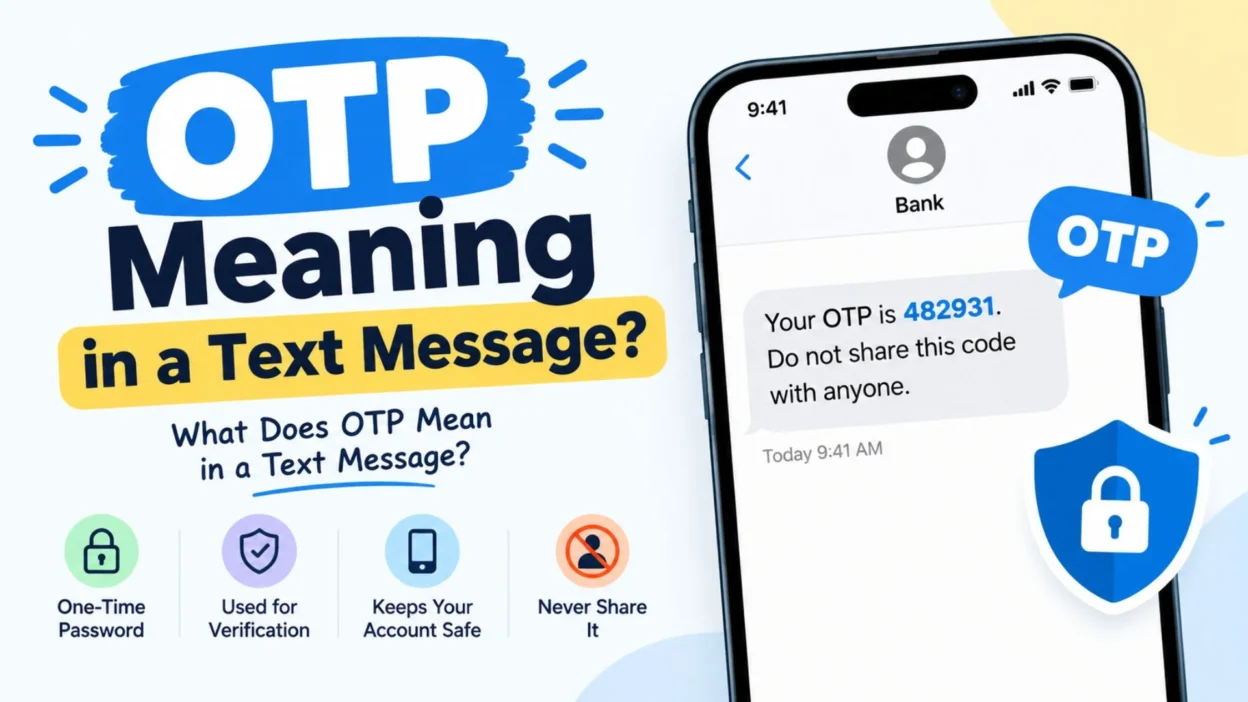
If someone sends you “OTP” in a message, the meaning can depend on the conversation. In most cases, OTP means “One-Time Password.” It is a temporary code used to verify your identity.
However, OTP can also have other meanings in texting and online chats. In fandoms and social media, it can mean “One True Pairing.” Knowing the context helps you understand which meaning someone intends.
What Does OTP Mean in Text?
The most common OTP meaning in text is “One-Time Password.” You may see it when logging in, making a payment, or confirming an account.
- OTP = One-Time Password
- It is usually a temporary code
- The code may contain numbers or letters
- Many OTPs expire quickly
- Banks often use OTPs for verification
- Shopping websites may send OTPs
- Apps can use OTPs during login
- Email services may use OTP verification
- Phone numbers can be verified with OTPs
- An OTP helps confirm your identity
- The code is usually sent by SMS
- Some services send OTPs by email
- Authentication apps can also generate OTPs
- Never share an OTP with strangers
- A real OTP should be used only for its intended purpose
OTP Meaning in Chat
In casual chat, OTP may have a different meaning. The conversation around the word usually gives you the best clue.
- OTP can mean One-Time Password
- OTP can mean One True Pairing
- Tech conversations often use the password meaning
- Fan communities often use the pairing meaning
- Gaming chats may use either meaning
- Social media posts can use OTP creatively
- A login message usually means One-Time Password
- A relationship discussion may mean One True Pairing
- Context is more important than the abbreviation alone
- The same three letters can have different meanings
- Asking for context can prevent confusion
- Look at the words before and after OTP
- Consider who sent the message
- Think about what you were discussing
- When unsure, simply ask what they mean
OTP as One-Time Password
A One-Time Password is a temporary security code. It is designed to work for a limited time or a specific action.
- OTPs help verify users
- They add an extra security layer
- Many codes expire within minutes
- Some codes work only once
- Banks commonly use OTP verification
- Websites may request an OTP during login
- Apps may require OTPs after registration
- Payment services can use OTPs
- Password recovery may involve an OTP
- Phone verification often uses OTPs
- Email verification can also use temporary codes
- OTPs reduce some account security risks
- Codes should be entered carefully
- A wrong code may fail verification
- You may request another code if one expires
OTP Meaning on Social Media
Social media users can use OTP in different ways. The exact meaning depends heavily on the post, comment, or private message.
- OTP can mean One-Time Password
- OTP can also mean One True Pairing
- Fan pages often use OTP for favorite couples
- Entertainment discussions may use the pairing meaning
- Security posts usually use the password meaning
- Comments can make the intended meaning obvious
- Hashtags may provide extra context
- A romance post may use OTP differently
- A login alert almost always suggests One-Time Password
- Social media slang changes with communities
- Different groups may use the same abbreviation differently
- Check the surrounding conversation
- Avoid assuming one meaning every time
- Ask politely when the meaning is unclear
- Context makes online abbreviations easier to understand
OTP Meaning in Text Messages
When OTP appears in a normal text message, it usually refers to a verification code. For example, a service may send a code after you request a login.
- “Your OTP is 482913.”
- “Enter the OTP to continue.”
- “I received an OTP.”
- “The OTP expired.”
- “Please resend the OTP.”
- “My OTP is not working.”
- “Enter the OTP sent to your phone.”
- “Your verification OTP has arrived.”
- “The OTP is valid for a short time.”
- “I need a new OTP.”
- “The code expired before I entered it.”
- “The website asked for an OTP.”
- “My login OTP arrived late.”
- “I received the verification code.”
- “The OTP helped confirm my account.”
OTP Meaning in Banking
Banks frequently use OTPs to confirm certain actions. These codes are usually sent to a registered phone number or generated through an approved authentication method.
- OTP can confirm a banking action
- It may verify an online transaction
- Banks can use OTPs during login
- Some payments require additional verification
- A bank may send the code by SMS
- The code may have a short validity period
- Never give a banking OTP to another person
- Bank employees should not ask for your private OTP
- Enter codes only on trusted banking pages
- Check the message before entering a code
- Do not post an OTP publicly
- Ignore unexpected OTP messages
- Contact your bank if suspicious codes keep arriving
- Use official banking channels for support
- Treat an OTP like a temporary security key
OTP Meaning in Apps
Many apps use OTP verification when you create or access an account. This helps confirm that you control the phone number or email connected to the account.
- Messaging apps may use OTPs
- Shopping apps can request verification codes
- Finance apps may use OTP security
- Social platforms can use phone verification
- Delivery apps may verify phone numbers
- Login systems can send temporary codes
- Account recovery may involve OTPs
- New devices can trigger verification
- Codes may arrive by text message
- Some apps offer email verification
- Authentication apps may generate temporary codes
- Expired codes usually need replacement
- Incorrect codes may prevent login
- Only use codes from trusted sources
- Keep your account details private
OTP Meaning in Relationships and Fandoms
There is another popular meaning of OTP: “One True Pairing.” Fans use this term when talking about a favorite fictional or celebrity pairing.
- OTP can describe a favorite fictional couple
- Fans may call two characters their OTP
- The term appears in fandom communities
- It can describe a strongly preferred pairing
- Fans may discuss their favorite OTP online
- TV shows often inspire OTP discussions
- Movies can have popular OTPs
- Books can create memorable pairings
- Anime communities commonly discuss character pairings
- Gaming communities may use the term too
- OTP does not always mean a real-life relationship
- It can refer to fictional characters
- Fans may compare different pairings
- Social posts can feature favorite OTP moments
- Context tells you whether OTP means pairing or password
OTP Meaning in Online Slang
Online slang often turns short abbreviations into flexible expressions. OTP is a good example because it has more than one widely recognized meaning.
- OTP is short and easy to type
- Internet communities create their own slang
- Different platforms can use abbreviations differently
- Texting often favors short expressions
- Context determines the intended meaning
- Fandom slang can differ from tech slang
- Gaming communities may create additional meanings
- Social media users often shorten common phrases
- Abbreviations save typing time
- Some slang terms become widely accepted
- New meanings can appear over time
- Not every OTP means the same thing
- Look for clues in the conversation
- Ask the sender if necessary
- A quick question can solve the confusion
How to Know Which OTP Meaning Is Intended
Seeing “OTP” alone may not be enough. The subject of the conversation usually gives you the answer.
- Look at the topic being discussed
- Check whether a login is involved
- Notice if someone mentions a code
- Look for words like “verify”
- Watch for words like “password”
- Romance discussions may suggest One True Pairing
- TV discussions can point toward fandom slang
- Banking messages usually indicate One-Time Password
- Login alerts strongly suggest the security meaning
- Fan conversations may suggest the pairing meaning
- Consider the sender
- Review the previous messages
- Check the full sentence
- Ask for clarification if needed
- Do not guess when security is involved
OTP Examples in Everyday Texting
Examples make the difference between the two meanings easier to understand.
- “Please enter the OTP to log in.” — One-Time Password
- “I just got my OTP.” — One-Time Password
- “The OTP expired.” — One-Time Password
- “Can you resend the OTP?” — One-Time Password
- “Did you get the OTP?” — One-Time Password
- “They are my OTP!” — One True Pairing
- “That couple is my OTP.” — One True Pairing
- “I finally found my OTP.” — One True Pairing
- “Everyone knows they are the best OTP.” — One True Pairing
- “This show has so many OTP debates.” — One True Pairing
- “Enter your OTP before continuing.” — One-Time Password
- “My OTP never arrived.” — One-Time Password
- “The website requested an OTP.” — One-Time Password
- “Those two characters are my OTP.” — One True Pairing
- “Their story made them my new OTP.” — One True Pairing
OTP vs. Verification Code
People often use OTP and verification code as if they mean exactly the same thing. In many everyday situations, they refer to a temporary code used to confirm an action.
- OTP stands for One-Time Password
- Verification code is a broader phrase
- Both can help confirm identity
- Both may arrive by text
- Both can arrive by email
- Some codes expire quickly
- Some codes work only once
- OTP is a specific type of temporary credential
- Verification code can describe several types of codes
- Apps may use either term
- Websites may call the code a security code
- Banks may call it an OTP
- Login systems can use temporary codes
- The exact wording depends on the service
- Always follow the instructions from the official service
Why Do Websites Send OTP Codes?
Websites use OTPs as part of identity and account verification. The code helps confirm that the person completing an action has access to a trusted device or account.
- OTPs can confirm phone ownership
- They can verify email access
- They can support account login
- They can protect certain account actions
- They can add another security step
- They can help during account recovery
- They can verify new devices
- They can confirm some payments
- They can reduce unauthorized access
- They can make suspicious activity harder
- Temporary codes are not permanent passwords
- Many codes expire quickly
- Each code may be unique
- Codes can be generated automatically
- OTP systems are common across online services
What Should You Do If You Receive an Unexpected OTP?
An unexpected OTP can happen for several reasons. Someone may have entered your number by mistake, or someone could be attempting to access an account.
- Do not share the code
- Do not post the code online
- Do not forward the OTP
- Do not tell strangers the numbers
- Check which service sent the message
- Review your recent account activity
- Change your password if something seems wrong
- Use official support channels when needed
- Enable additional security features
- Watch for suspicious login alerts
- Ignore requests from unknown people
- Never trust pressure tactics
- Do not click strange links
- Keep your account information private
- Contact the service if unexpected codes continue
Common OTP Text Message Examples
Real OTP messages can look different depending on the service. Their wording may change, but the purpose is usually similar.
- “Your verification code is 615204.”
- “Use this OTP to complete your login.”
- “Your one-time code has arrived.”
- “Enter the code to verify your phone.”
- “Your OTP will expire shortly.”
- “Use this code to confirm your account.”
- “Your login verification code is ready.”
- “Enter the temporary code to continue.”
- “Your security code is 381927.”
- “Please enter the OTP shown in this message.”
- “This code is valid for a limited time.”
- “Your verification code has been generated.”
- “Use the code to complete registration.”
- “Enter the code to confirm your request.”
- “A new OTP has been sent to your phone.”
Common Questions About OTP in Texting
The abbreviation can be confusing when you first see it. These quick points cover the most common situations.
- OTP usually means One-Time Password
- OTP can also mean One True Pairing
- Banking messages often use the password meaning
- Fandom conversations often use the pairing meaning
- OTP codes are usually temporary
- Some OTPs expire after a short period
- OTPs can arrive through SMS
- OTPs can also arrive through email
- Authentication apps can generate OTPs
- Never share security codes
- An OTP is different from a permanent password
- The meaning depends on context
- “My OTP arrived” usually means a security code
- “They are my OTP” usually means a favorite pairing
- Asking for context is always okay
Is OTP the Same as a Password?
An OTP is related to passwords, but it is not usually a permanent password. The biggest difference is that an OTP is designed for temporary or limited use.
- A normal password can be reused
- An OTP is usually temporary
- OTPs often expire
- OTPs may work only once
- Passwords are normally created by users
- OTPs are often generated automatically
- Passwords can protect accounts continuously
- OTPs often verify specific actions
- Both can be part of account security
- Both should be kept private
- Never share your login password
- Never share your OTP
- Use strong passwords for important accounts
- Follow official security instructions
- Treat temporary codes as private information
Why Do People Say “My OTP”?
The phrase “my OTP” can mean different things depending on the conversation. In security chats, it usually means a one-time verification code. In fandom chats, it often means a favorite pairing.
- “My OTP arrived” usually means a security code
- “My OTP expired” usually means a temporary code
- “My OTP is not working” usually means verification
- “They are my OTP” usually means a favorite pairing
- “That is my OTP” may refer to fictional characters
- “Send me the OTP” may refer to verification
- Context changes the meaning completely
- Security conversations favor the password meaning
- Entertainment conversations may favor the pairing meaning
- Fandom conversations commonly use the pairing meaning
- Tech support usually means One-Time Password
- Romance discussions may use One True Pairing
- Look at the sentence around OTP
- Think about the topic
- Ask when the meaning is unclear
OTP Meaning in Different Online Communities
Different online communities may use OTP in different ways. Understanding the community can make the abbreviation much easier to decode.
- Banking communities use OTP for security
- Technology forums use OTP for authentication
- Shopping platforms use OTP for verification
- Gaming communities can use both meanings
- TV fandoms often use OTP for pairings
- Movie fans may use OTP for favorite couples
- Anime communities use OTP for character pairings
- Book communities may discuss fictional OTPs
- Social media can use both meanings
- Messaging apps often use OTP for login
- Security discussions usually mean One-Time Password
- Fan discussions often mean One True Pairing
- Community language can shape meaning
- Slang is not always universal
- Context remains the best guide
Tips for Understanding Text Abbreviations
OTP is just one example of how short online terms can have multiple meanings. A few simple habits can help you understand them.
- Read the whole message
- Do not focus on one abbreviation
- Check the previous message
- Look at the topic
- Consider who sent it
- Notice nearby keywords
- Search for context when needed
- Ask the sender politely
- Avoid making quick assumptions
- Learn common texting abbreviations
- Remember that slang changes
- Consider the platform
- Consider the community
- Watch for security-related words
- When money or accounts are involved, be extra careful
FAQs
What does OTP mean in text?
OTP most commonly means One-Time Password, a temporary code used for verification. In fandom conversations, it can also mean One True Pairing.
What does OTP mean in a text message from a bank?
When a bank sends an OTP, it usually means One-Time Password. The code may be used to verify a login, payment, or other account action.
What does OTP mean on social media?
On social media, OTP can mean either One-Time Password or One True Pairing. The surrounding conversation tells you which meaning is intended.
Is OTP the same as a verification code?
Often, yes in everyday use. An OTP is a temporary code used for verification, while “verification code” is a broader term that can describe different types of security codes.
Should I share my OTP with someone?
No. A security OTP should be treated as private. Do not share it with strangers, callers, messages, or anyone who pressures you for the code.
Conclusion
The main OTP meaning in text is One-Time Password, especially in banking, apps, websites, and account verification. However, One True Pairing is another popular meaning in fandom and entertainment conversations.
When you see OTP, check the context before deciding what it means. A little attention can save you from a lot of confusion.
If this guide helped you understand OTP, share it with a friend, save it for later, or leave a comment with another texting abbreviation you want explained.

Muhammad Shahroz is a passionate writer who creates helpful content about messages and word meanings. He is committed to providing clear, accurate, and easy-to-understand information on TextsMessagez.com.