If you have searched for the Cash App spam text message settlement, you may be wondering whether the settlement is real, who qualified, how much people received, and whether you can still file a claim.
The short answer is yes, the settlement was real. However, the claims period is now closed.
The case involved allegations that Cash App’s “Invite Friends” referral program helped users send unsolicited commercial text messages to Washington residents. Block, Inc., Cash App’s parent company, denied wrongdoing but agreed to a $12.5 million settlement. The court later gave the settlement final approval.
What Is the Cash App Spam Text Message Settlement?
The Cash App spam text message settlement comes from a federal class action called Bottoms v. Block, Inc.
The lawsuit was filed in the U.S. District Court for the Western District of Washington. It focused on text messages connected to Cash App’s “Invite Friends” referral program.
According to the settlement website, the lawsuit alleged that Block substantially assisted users in sending unsolicited commercial text messages to Washington residents through that referral program.
Block denied the allegations and maintained that it complied with applicable state and federal laws. The settlement resolved the lawsuit without Block admitting wrongdoing.
The important details are:
- Case: Bottoms v. Block, Inc.
- Case number: 2:23-cv-01969-MJP
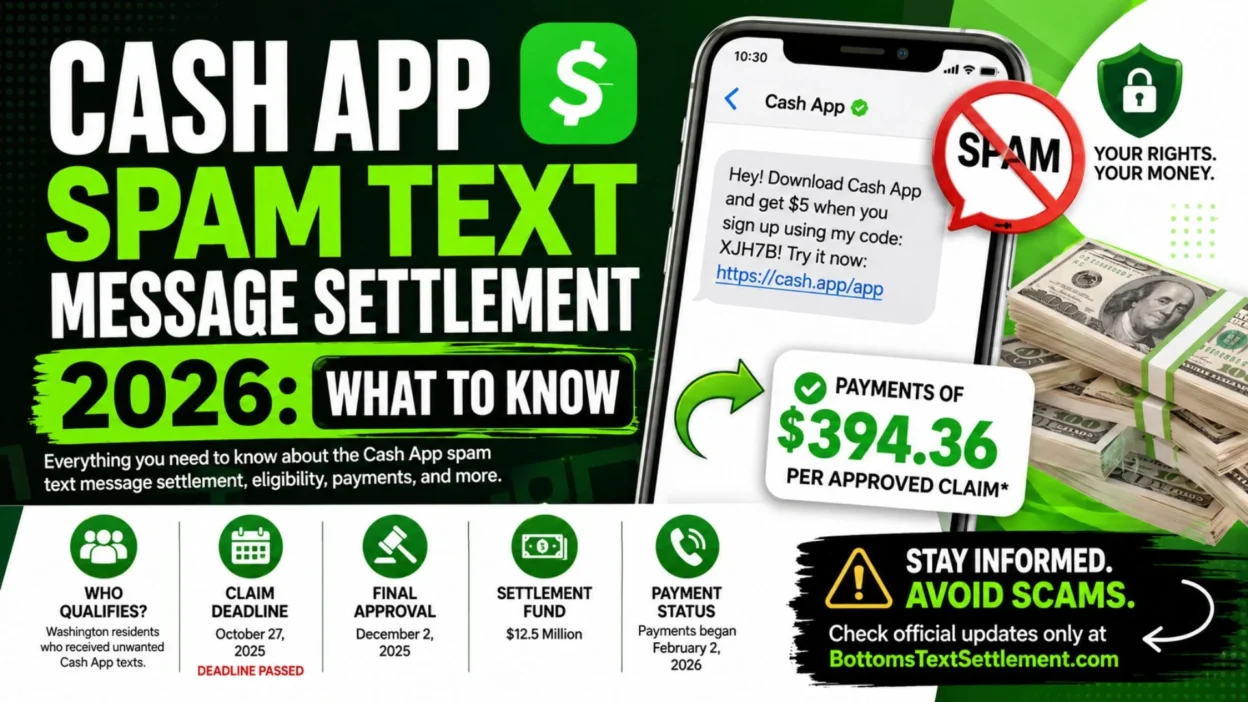
- Settlement fund: $12.5 million
- Relevant state: Washington
- Program involved: Cash App “Invite Friends”
- Claim deadline: October 27, 2025
- Final approval: December 2, 2025
- Initial accepted-claim award: $394.36
Why Was Cash App Involved in a Spam Text Lawsuit?
The lawsuit was not about every text message sent by Cash App.
Instead, it focused on referral messages associated with the “Invite Friends” feature.
The feature allowed Cash App users to invite contacts to use the service. The lawsuit claimed that some of these messages were sent without the recipient giving clear and affirmative consent.
The case raised questions under Washington law, including the state’s Commercial Electronic Mail Act and Consumer Protection Act.
That distinction matters.
A normal payment notification, account alert, or security message is not automatically part of this settlement. The lawsuit specifically concerned text messaging connected with the referral program.
Who Was Eligible for the Cash App Settlement?
Eligibility was limited to a specific group.
According to the settlement materials, the class generally covered people who:
- Lived in Washington during the relevant period.
- Received a Cash App referral text.
- Received the message through the “Invite Friends” program.
- Received the message between November 14, 2019, and August 7, 2025.
- Had not clearly and affirmatively consented to receive the relevant messages.
- Submitted a valid claim before the deadline.
This means simply having a Cash App account did not make someone eligible.
Likewise, receiving any random Cash App text did not automatically qualify a person for payment.
The settlement was tied to a particular type of referral message and a specific class definition.
Can You Still File a Claim in 2026?
No. The original claim deadline has passed.
The official settlement website lists October 27, 2025 as the claims deadline. The same date was also the deadline for exclusion and objections.
That means someone discovering the settlement for the first time in August 2026 cannot simply submit a new claim.
This is important because older articles and social media posts may still contain the original claim instructions.
If you see a page telling you that you can still submit a new claim, check the date carefully.
The official settlement website currently shows the claims deadline as passed.
How Much Was the Cash App Spam Text Settlement?
The settlement fund was $12.5 million.
Before payments were calculated, the settlement materials estimated that eligible claimants might receive between $88 and $147.
However, that was only an estimate.
The final amount depended on the number of valid claims and the costs deducted from the settlement fund.
The official settlement website later reported a $394.36 settlement award per accepted claim for the distribution.
That is why you may see two different numbers online.
The $88–$147 figure came from the earlier estimate.
The $394.36 figure reflects the later distribution amount reported by the settlement administrator.
Why Was the Final Payment Higher Than the Original Estimate?
This is one of the easiest parts of the case to misunderstand.
A class action settlement often provides an estimated payment before the final number of valid claims is known.
In this case, the original estimate was $88 to $147.
After the claims process, the actual distribution calculation produced a higher award.
The official administrator now lists the settlement award as $394.36 per accepted claim.
So if you see an old article saying “Cash App settlement pays up to $147,” that information may refer to the earlier estimate rather than the final distribution.
When Did Settlement Payments Begin?
The settlement entered the payment stage after final court approval.
The official website states that the court granted final approval on December 2, 2025.
The administrator later posted a distribution update explaining that failed digital payments and returned mail checks had been processed and reissued. It also stated that accepted claims had a $394.36 award.
This means the settlement is no longer in the “waiting for approval” stage.
It is in the distribution and administration stage.
That difference is important when reading older settlement articles.
What Payment Methods Were Available?
The settlement claim process allowed eligible claimants to choose from available payment methods.
The settlement FAQ lists options including paper checks, Venmo, and PayPal.
Depending on the claim and payment process, people could receive their settlement through an electronic method or by mail.
If a payment failed or a mailed check was returned, the administrator could handle the reissue process.
The official April 1, 2026 update said failed digital payments and returned mail checks had been processed and reissued as paper checks.
What If You Filed a Claim but Never Received Your Money?
This is different from trying to file a new claim.
If you already submitted a valid claim, you can contact the settlement administrator about your individual payment status.
The official website says that people who had not received a reissued check after the stated delivery period should contact the administrator.
The settlement administrator lists:
- Phone: 1-877-540-7545
- Email: info@BottomsTextSettlement.com
- Mail: Bottoms v Block Settlement Administrator, PO Box 2631, Baton Rouge, LA 70821
The administrator also specifically says not to contact the judge or court about individual payment questions.
Is the Cash App Spam Text Message Settlement Legit?
Yes.
The lawsuit and settlement are legitimate.
The official settlement website is maintained for Bottoms v. Block, Inc., and the court approved the settlement in December 2025.
However, there is an important difference between a real settlement and a real-looking message about the settlement.
Scammers can copy the name of a genuine class action.
They may use the real case name while sending a fake payment request.
For that reason, always verify settlement information through the official administrator.
How to Spot a Fake Cash App Settlement Message
Be careful if someone contacts you unexpectedly and asks for sensitive information.
A legitimate settlement payment should not require you to hand over your Cash App password or PIN.
Watch for warning signs such as:
- Requests for an upfront payment.
- Claims that you must pay to “unlock” your settlement.
- Requests for your Cash App PIN.
- Requests for your account password.
- Requests for one-time verification codes.
- Suspicious links.
- Strange website addresses.
- Pressure to act immediately.
- Promises of a much larger payment than the official settlement states.
- Requests to send cryptocurrency or gift cards.
When something feels rushed, stop and verify it.
The official settlement website says it is the only authorized website for this litigation and warns that other websites may contain incorrect information.
Is This Settlement for Everyone Who Received a Cash App Text?
No.
That is another common misunderstanding.
The settlement was not designed to compensate every person who ever received a Cash App message.
The case involved a specific type of referral text and a defined class.
For example, an ordinary Cash App transaction notification does not automatically make someone a settlement class member.
The settlement materials focus on messages connected to the “Invite Friends” program.
Eligibility also depended on factors such as Washington residency and the relevant time period.
What Was the “Invite Friends” Program?
Cash App’s “Invite Friends” feature was designed as a referral tool.
It allowed existing users to invite contacts to use Cash App.
The lawsuit alleged that some of the resulting messages were unsolicited commercial text messages.
The legal question was not simply whether Cash App had a referral program.
Instead, the lawsuit focused on how the referral messages were transmitted and whether the recipients had provided the required consent under Washington law.
Block denied the allegations.
The settlement resolved the dispute without an admission of wrongdoing.
Did Block Admit It Broke the Law?
No.
This point is worth making clearly.
Block agreed to settle the lawsuit, but the settlement did not require Block to admit wrongdoing.
The official settlement website says Block denied any wrongdoing and maintained that it complied with state and federal law.
A settlement is an agreement to resolve a legal dispute.
It does not automatically mean that every allegation made in a lawsuit was proven true.
What Happens If Someone Did Nothing?
The settlement FAQ explains that class members who stayed in the settlement but did not submit a claim would not receive a settlement payment.
At the same time, once the settlement became final, members who remained in the class were generally bound by the settlement and released the covered claims.
That is why the claim deadline mattered.
Doing nothing was not the same as filing a claim.
What Was the Final Approval Date?
The court entered final approval on December 2, 2025.
That date marked an important step in the case.
Before final approval, the settlement still had to go through the court’s approval process.
After approval, the settlement moved into administration and payment distribution.
The official settlement website lists December 2, 2025, as the final approval date.
Why Are People Still Searching for the Settlement in 2026?
The simple answer is payments.
Even after a claims deadline passes, people may continue searching for a settlement because they hear that others received checks or electronic payments.
That can create a new wave of interest.
People may ask:
- Was the settlement real?
- Did approved claimants get paid?
- How much was the payment?
- Can I still file?
- Where did the check come from?
- Why did someone receive $394.36?
- What should I do if my payment failed?
Those are reasonable questions.
However, the answer depends on whether someone already filed a valid claim.
For new applicants, the claims deadline has passed.
For existing claimants, the administrator is the appropriate source for payment questions.
Why You Should Be Careful With Old Settlement Articles
Settlement information changes over time.
An article written before final approval may contain information that was accurate at the time but is no longer current.
For example, early settlement materials estimated payments at $88 to $147.
The official site now reports $394.36 per accepted claim.
Likewise, an old page may tell readers to submit a claim.
That instruction is outdated now because the October 27, 2025 deadline has passed.
For a 2026 article, the current status should be placed near the top rather than buried at the end.
What Is the Current Cash App Settlement Status in 2026?
As of August 2026, the Cash App spam text message settlement is closed to new claims.
The major milestones are:
November 14, 2019: The class period begins.
August 7, 2025: The class period ends.
October 27, 2025: Claim, exclusion, and objection deadlines pass.
December 2, 2025: The court grants final approval.
2026: Settlement distributions and payment administration take place.
The official website’s April 1, 2026 update says failed digital payments and returned checks were reissued, and it identifies $394.36 as the settlement award per accepted claim.
So the most useful 2026 takeaway is simple:
You cannot submit a new claim now, but existing accepted claims can still be addressed through the settlement administrator if there is a payment issue.
How to Verify Settlement Information Safely
The safest approach is surprisingly simple.
Start with the official settlement website.
Then compare the information you see with the case details.
Check the case name, court, deadline, and administrator.
Do not rely only on a social media post or a screenshot.
For this case, the official settlement website identifies itself as the only authorized website for the litigation.
If you have a payment question, use the administrator’s official contact details.
That is much safer than replying to an unexpected message.
Cash App Spam Text Message Settlement vs. Other Cash App Cases
Another reason people get confused is that Cash App and Block have been involved in other legal matters.
Not every Cash App settlement is the same.
A different case can have:
- A different lawsuit name.
- A different court.
- A different settlement administrator.
- Different eligibility requirements.
- A different payment amount.
- A different claim deadline.
- A different legal issue.
Therefore, seeing “Cash App settlement” on a check or website is not enough to identify the case.
Always look for the actual case name.
For the spam-text settlement discussed here, the case is Bottoms v. Block, Inc., No. 2:23-cv-01969-MJP.
FAQs
Can I still apply for the Cash App spam text message settlement?
No. The claim deadline was October 27, 2025. The official settlement website now lists the deadline as passed.
How much did the Cash App spam text settlement pay?
The official settlement website reports a $394.36 award per accepted claim for the distribution. Earlier materials had estimated $88 to $147, but that was only an estimate.
Who qualified for the settlement?
The settlement generally covered eligible Washington residents who received qualifying Cash App “Invite Friends” referral texts during the specified class period and submitted a valid claim on time.
Is the Cash App spam text message settlement a scam?
No. The settlement itself is legitimate. However, fake messages can use the name of a real settlement, so payment requests should always be verified through the official administrator.
What if I filed a claim but did not receive my payment?
Contact the official settlement administrator. The listed phone number is 1-877-540-7545, and the email is info@BottomsTextSettlement.com.
Did Block admit wrongdoing?
No. Block denied the allegations and agreed to settle without admitting wrongdoing.
Final Thoughts
The Cash App spam text message settlement was a real class action involving allegations about unsolicited referral texts sent through Cash App’s “Invite Friends” program.
The case resulted in a $12.5 million settlement fund. The court granted final approval on December 2, 2025, and the official settlement website now reports a $394.36 award per accepted claim.
The most important update for 2026 is that the claims deadline has passed.
If you already filed a valid claim and are waiting for a payment, use the official settlement administrator for help. If you never filed a claim, be careful with websites or messages that promise to let you submit a new application now.
A real settlement can still attract fake messages. When in doubt, verify first.

Muhammad Shahroz is a passionate writer who creates helpful content about messages and word meanings. He is committed to providing clear, accurate, and easy-to-understand information on TextsMessagez.com.