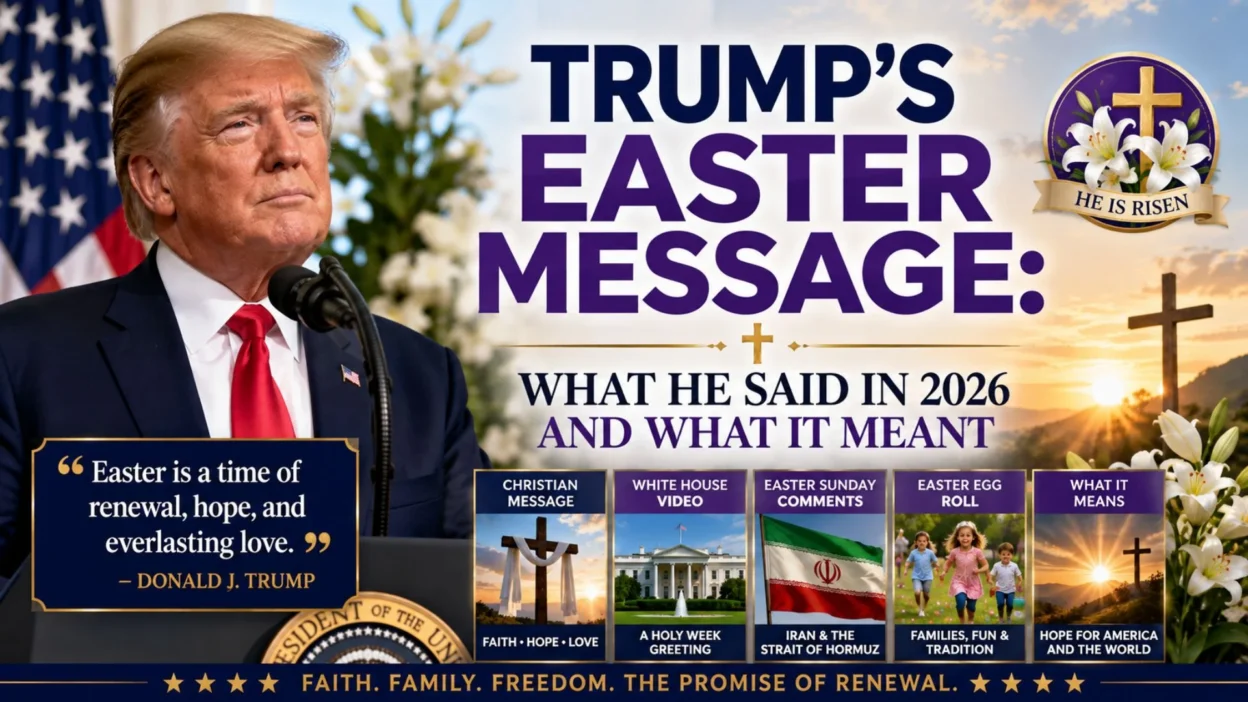
Trump’s Easter message in 2026 received attention because it included both a traditional Easter greeting and political comments linked to the conflict with Iran.
President Donald Trump and First Lady Melania Trump shared a Holy Week message focused on Easter, faith, hope, and the resurrection of Jesus Christ. A separate Easter Sunday post later took a much more political tone.
This guide explains the main messages, the timing, the public response, and the difference between Trump’s religious Easter remarks and his political comments.
What Was Trump’s Easter Message in 2026?
The 2026 Easter message appeared in more than one form.
The White House released a Holy Week video and a formal presidential message, while Trump also posted separately on social media.
- 🇺🇸 Trump wished Americans a Happy Easter.
- ✝️ The official message focused on the resurrection of Jesus Christ.
- 🙏 The White House message emphasized faith and hope.
- 🌎 The message addressed Christians in the United States and around the world.
- ❤️ It described Easter as a celebration of redemption.
- 🌅 It connected Easter with hope.
- 📖 The formal message discussed Christian beliefs.
- 🕊️ The tone of the official message was religious.
- 🎥 Trump also delivered a Holy Week video message.
- 🇺🇸 The video ended with a blessing for America.
- 📅 Easter Sunday fell on April 5, 2026.
- 🗓️ Good Friday occurred on April 3.
- 📣 Trump also posted separate political remarks on Easter Sunday.
- 🌍 Those remarks focused heavily on Iran.
- 📰 The combination created significant media attention.
The formal 2026 presidential Easter message was published on April 3 and described Easter as a celebration of Christ’s resurrection, redemption, and hope.
Trump’s Easter Message and the White House Video
The White House also published a Holy Week video featuring Trump.
The short message was more traditional than some of his later Easter-day social media comments.
- 🎥 Trump addressed viewers during Holy Week.
- ✝️ The message referred to Easter.
- 🙏 Faith was central to the video.
- 🌎 Christians around the world were mentioned.
- ❤️ Hope was an important theme.
- 🇺🇸 Trump spoke about the United States.
- 🌟 The tone was celebratory.
- 🕊️ The message highlighted Christian belief.
- 📅 The video appeared before Easter Sunday.
- 🎬 The White House published the video officially.
- 👤 Trump delivered the message directly.
- 💬 The greeting was brief.
- 🇺🇸 It included a blessing for America.
- 🌅 The message looked toward Easter with optimism.
- 📢 It differed in tone from the later political post.
The White House’s published video description summarized Trump’s message as a Happy Easter greeting and included a request for God’s blessing on the United States.
The Main Themes in Trump’s Easter Message
The formal message centered on familiar Christian Easter themes.
Rather than focusing mainly on politics, it described Easter through faith and religious belief.
- ✝️ Resurrection
- 🙏 Faith
- ❤️ God’s love
- 🌅 Hope
- 🕊️ Redemption
- 📖 Christian belief
- 🌎 Global Christian observance
- 💛 Spiritual renewal
- 🌿 New creation
- 🙌 Victory over death
- ⛪ Christian worship
- ✨ Eternal hope
- 🇺🇸 American religious life
- 🤝 Shared celebration
- 🌟 Easter joy
The American Presidency Project’s transcript records the formal message as focusing on the resurrection of Jesus and the Christian promise of redemption and eternal life.
Why Trump’s Easter Message Got Attention
The message attracted attention for more than one reason.
The biggest factor was the contrast between Trump’s traditional Easter remarks and his later political statements.
- 📰 Multiple messages appeared around Easter.
- 📱 Social media played a major role.
- ✝️ The formal message was religious.
- 🇺🇸 The White House message was patriotic.
- 🌍 The message addressed Christians worldwide.
- ⚔️ Later comments turned toward Iran.
- 🌐 International events shaped the news cycle.
- 📺 Television outlets covered the statements.
- 🗞️ News organizations compared the messages.
- 💬 Supporters and critics reacted differently.
- 📱 Truth Social became part of the discussion.
- 🏛️ The White House Easter setting added context.
- 👨👩👧 The holiday also included family events.
- 🥚 The annual Easter Egg Roll brought additional attention.
- 🔎 Search interest increased around the statements.
AP reported that Trump’s 2026 Easter communications included both religious messaging and a controversial Easter Sunday post involving Iran.
Trump’s Easter Message Compared With 2025
Looking at 2025 helps explain how the messaging evolved.
In 2025, Trump posted a religious Easter greeting wishing people peace and joy as Christians celebrated the resurrection. He also posted a separate, much more political Easter message.
- 📅 Easter 2025 was April 20.
- ✝️ One 2025 message focused on Easter faith.
- 🙏 Peace was part of the greeting.
- 😊 Joy was also emphasized.
- 📱 The message appeared on Truth Social.
- 🇺🇸 Trump included national themes.
- 🗣️ Another post attacked political opponents.
- ⚖️ Judges were criticized in that post.
- 🏛️ Biden was criticized as well.
- 📰 The political post received widespread coverage.
- 🔎 Fact-checkers verified its authenticity.
- 📣 The two messages had different tones.
- ✝️ One was mainly religious.
- 🗳️ The other was strongly political.
- 📚 The contrast became part of the Easter 2025 discussion.
Lead Stories confirmed that Trump’s controversial 2025 Easter post was authentic and was published on Easter Sunday.
Trump’s Easter Message and Christian Themes
The formal 2026 message used language that is familiar within Christian Easter observance.
It described the resurrection as central to Christian hope.
- ✝️ Jesus Christ was central to the message.
- 🙏 Resurrection was emphasized.
- ❤️ Love was highlighted.
- 🌅 Hope appeared as a major theme.
- 🕊️ Redemption was discussed.
- 📖 Christian theology shaped the message.
- 🌎 Christians worldwide were included.
- ⛪ Easter was treated as a religious observance.
- 🌟 The tone was celebratory.
- 💛 Spiritual hope was emphasized.
- 🌿 Renewal was another theme.
- 🕯️ The message referenced sacrifice.
- ✨ It connected Easter with eternal hope.
- 🤝 It addressed believers broadly.
- 🇺🇸 It also connected faith with American life.
The formal message was not simply a generic holiday greeting. It explicitly presented Easter through Christian theology.
Trump’s Easter Message and Hope
Hope was one of the strongest themes in the official 2026 statement.
The message connected Easter with the Christian belief that death does not have the final word.
- 🌅 Hope for believers
- 🙏 Hope through faith
- ✝️ Hope through resurrection
- ❤️ Hope through divine love
- 🕊️ Hope during hardship
- 🌎 Hope for communities
- 🇺🇸 Hope for the nation
- 🌿 Hope for renewal
- ✨ Hope for the future
- 💛 Hope beyond suffering
- 📖 Hope rooted in Christian belief
- 🤝 Hope shared with others
- ⛪ Hope celebrated at Easter
- 🌟 Hope as a spiritual theme
- 🕯️ Hope connected with redemption
This is also why Easter messages often receive attention beyond the specific political figure delivering them.
Trump’s Easter Message and American Identity
The formal message also connected Christian belief with American identity.
This is a recurring feature of presidential Easter statements, where religious observance may appear alongside references to the country.
- 🇺🇸 America was included in the message.
- ✝️ Christianity was discussed.
- 🏛️ The presidency provided the platform.
- 🙏 Faith was presented publicly.
- 🌎 The message addressed a global Christian audience.
- 🗽 American identity was part of the framing.
- 🤝 National unity appeared as a broader theme.
- ❤️ Love was connected with Christian belief.
- 🌅 Hope was connected with the country’s future.
- 📖 Religious language was prominent.
- 🕊️ Peace appeared in the broader Easter context.
- 🌟 The message celebrated Easter.
- 🎥 The White House shared video content.
- 📱 Social media expanded the audience.
- 📰 News coverage widened the discussion.
The White House’s 2026 Easter and Holy Week communications show how the administration presented the holiday through both Christian and national themes.
The Separate Easter Sunday Political Post
The most controversial part of the 2026 Easter coverage was not the formal religious message.
It was a separate Easter Sunday social media post concerning Iran.
- 🇮🇷 Iran was the main subject.
- ⚔️ The post discussed the Strait of Hormuz.
- 🗣️ Trump’s language was highly aggressive.
- 📰 News organizations widely reported the post.
- 🌍 International tensions were already high.
- 💥 Trump threatened military action.
- 🚢 The Strait was central to the dispute.
- 🛢️ The waterway has major global economic importance.
- 📱 The statement appeared on Truth Social.
- 🗓️ It appeared on Easter Sunday.
- 💬 The tone differed sharply from the formal Easter message.
- 📰 Critics focused on the timing.
- 🏛️ The statement became part of the administration’s Iran policy story.
- 🌎 International audiences also noticed it.
- 🔎 The contrast increased interest in the day’s messages.
Reuters reported that Trump used an Easter Sunday Truth Social post to threaten action against Iranian infrastructure if the Strait of Hormuz remained closed.
Why the Two Messages Seemed So Different
The contrast was striking.
One message centered on Easter faith. Another focused on a major geopolitical conflict.
- ✝️ Formal message: Christian faith
- 🌅 Formal message: hope
- ❤️ Formal message: redemption
- 🙏 Formal message: resurrection
- 🇺🇸 Video: America
- 🎥 Video: Holy Week
- 🇮🇷 Easter post: Iran
- 🚢 Easter post: Strait of Hormuz
- ⚔️ Easter post: military pressure
- 📰 Media: strong coverage
- 📱 Platform: social media
- 🌎 Context: international conflict
- 🏛️ Context: presidential leadership
- 🗓️ Timing: Easter Sunday
- 💬 Tone: sharply different
That contrast is a major reason Trump’s Easter message became a widely discussed search topic in 2026.
Trump’s Easter Message at the White House Easter Egg Roll
The White House Easter Egg Roll added another layer to the holiday coverage.
The annual event is designed around families and children, but political topics also appeared during Trump’s 2026 remarks.
- 🥚 The Easter Egg Roll took place at the White House.
- 👨👩👧 Families attended.
- 🎉 The event had a festive atmosphere.
- 🐰 Easter traditions were part of the day.
- 🇺🇸 Patriotic themes appeared.
- 👧 Children were present.
- 🎤 Trump addressed the crowd.
- 📰 Reporters asked about Iran.
- ⚔️ Trump discussed the conflict.
- 🥚 Egg prices were mentioned.
- 🇺🇸 America’s upcoming 250th anniversary was highlighted.
- 🎶 Entertainment formed part of the event.
- 🌸 Spring decorations filled the setting.
- 📺 The event received national coverage.
- 📰 Political and family themes overlapped.
The Washington Post reported that Trump’s 2026 Easter Egg Roll remarks mixed the holiday event with discussion of the Iran conflict and other political issues.
Public Reaction to Trump’s Easter Message
Public reaction varied sharply.
Some people focused on the religious message. Others focused on the political Easter Sunday post.
- 👍 Supporters praised the faith-focused remarks.
- 👎 Critics questioned the timing of the Iran statement.
- ✝️ Christian audiences discussed the religious language.
- 📰 Journalists examined the contrast.
- 📱 Social media amplified reactions.
- 🌍 International observers focused on Iran.
- 🇺🇸 Americans debated the national message.
- 💬 Political commentators offered different views.
- 🏛️ Constitutional questions appeared in some coverage.
- ⛪ Religious commentators examined the tone.
- 📺 Television programs discussed the posts.
- 🗞️ Newspapers compared the statements.
- 🔎 Search interest grew around the wording.
- 📱 Truth Social remained central.
- 🌐 Global media covered the controversy.
AP reported that several Trump administration agencies also published Easter messages celebrating Christ’s resurrection in 2026, adding to the broader religious messaging from the administration.
What Made the 2026 Message Different?
The 2026 Easter communication was notable because it contained several layers.
It was not one single statement with one simple tone.
- ✝️ There was a formal presidential message.
- 🎥 There was a White House video.
- 📱 There were Truth Social posts.
- 🇺🇸 America was part of the messaging.
- 🙏 Christianity was central to the formal statement.
- 🌅 Hope was emphasized.
- 🇮🇷 Iran dominated later political remarks.
- 🚢 The Strait of Hormuz became part of the Easter news.
- 📰 News coverage connected the pieces.
- 🏛️ The White House provided official context.
- 🌍 International events shaped the story.
- 🥚 The Easter Egg Roll added family imagery.
- 👨👩👧 Children were part of the holiday event.
- 📺 Television increased the reach.
- 📱 Social media created rapid reactions.
This combination made the 2026 holiday messaging unusually broad.
Trump’s Easter Message and the Role of Social Media
Social media played a major role in how the public encountered the statements.
A traditional presidential statement can take time to reach readers. A social media post can spread within minutes.
- 📱 Posts reach audiences quickly.
- 🔄 Users can repost statements.
- 💬 Comments create instant reactions.
- 📰 Journalists monitor presidential accounts.
- 🔎 Search engines index important statements.
- 🎥 Video can add emotional context.
- 📸 Screenshots spread quickly.
- 🌎 International audiences can see posts.
- 📣 Supporters can amplify messages.
- 🧐 Critics can scrutinize wording.
- 🗞️ News outlets can quote posts.
- 📊 Engagement can increase visibility.
- 💻 Digital platforms keep statements accessible.
- 🕐 Timing becomes especially important.
- 📚 Archived posts can support later research.
For readers, the best approach is to distinguish between an official presidential statement, a social media post, and commentary about those statements.
How to Understand Trump’s Easter Message Without Confusion
With multiple posts and reports, readers can easily mix different statements together.
A simple timeline helps.
- 📅 April 3: Holy Week message.
- 🎥 April 3: White House video.
- ✝️ April 3: Formal Easter message.
- 📅 April 5: Easter Sunday.
- 📱 April 5: Political Truth Social posts.
- 🇮🇷 April 5: Iran-related comments.
- 🥚 April 6: White House Easter Egg Roll.
- 📰 April 2026: Continued media coverage.
- 🔎 Readers searched for the original wording.
- 📚 Official records provided context.
- 🎥 Video provided another source.
- 📰 News reports added analysis.
- 🌎 International outlets covered Iran.
- 🇺🇸 U.S. outlets covered the White House.
- 🧐 Fact-checking helped separate claims.
Keeping the dates separate makes the story much easier to understand.
What Can Readers Learn From the Message?
Even when readers disagree about politics, the communication provides useful lessons about public messaging.
- 📢 A public figure can use multiple channels.
- 📰 Different messages can receive different reactions.
- ⏰ Timing affects public interpretation.
- 🎯 Audience matters.
- ✍️ Word choice matters.
- 📱 Social media can change a story quickly.
- 🏛️ Official statements carry institutional weight.
- 🎥 Video can create a different tone.
- 📰 News coverage adds context.
- 🔎 Primary sources help verify claims.
- 📚 Historical comparisons can be useful.
- 🌎 International events can reshape domestic stories.
- 💬 Public reaction can vary widely.
- 🧐 Readers should compare sources.
- ⚖️ Context is essential.
The biggest lesson is simple: read the original statement before relying only on a screenshot or social media summary.
Trump’s Easter Message: 2026 vs. Earlier Years
Presidential Easter messages can change with political circumstances.
Trump’s 2025 and 2026 communications show that clearly.
- 📅 2025 included a religious greeting.
- ✝️ 2025 included resurrection language.
- 📱 2025 also included a political post.
- 🗳️ Political opponents appeared in that post.
- 📅 2026 again included a religious message.
- ✝️ 2026 focused on resurrection.
- 🌅 Hope was prominent.
- 🇺🇸 America was highlighted.
- 🇮🇷 Iran became central to later remarks.
- 🚢 The Strait of Hormuz became a major issue.
- 📰 Media coverage was extensive.
- 📱 Social media shaped the response.
- 🎥 White House video added context.
- 🥚 The Easter Egg Roll added another public appearance.
- 🔎 Search interest connected the different statements.
This comparison shows why the phrase Trump’s Easter message can refer to more than one statement in a given year.
Why Primary Sources Matter
Political statements can quickly become distorted when they are shared without context.
Readers should check the original source whenever possible.
- 🏛️ Check White House releases.
- 📱 Check the original social media post.
- 🎥 Watch the complete video.
- 📅 Confirm the date.
- ⏰ Check the timing.
- 📰 Compare reputable news reports.
- 🔎 Look for corrections.
- 📚 Use archival sources when needed.
- 🧐 Separate quotes from commentary.
- ⚖️ Compare different viewpoints.
- 🌎 Consider international context.
- 🇺🇸 Consider domestic context.
- ✍️ Check exact wording.
- 📖 Read the full statement.
- 🚫 Avoid relying on screenshots alone.
The American Presidency Project provides a searchable record of presidential documents, including Trump’s 2026 Easter message.
Frequently Asked Questions
What was Trump’s Easter message in 2026?
The formal 2026 Easter message focused on the resurrection of Jesus Christ, Christian faith, redemption, and hope. Trump also delivered a separate Holy Week video greeting.
Did Trump post more than one Easter message?
Yes. The 2026 Easter coverage included a formal religious message and separate social media comments that addressed political and international issues.
What was controversial about Trump’s Easter Sunday post?
The controversy centered on his comments about Iran and the Strait of Hormuz. The tone was much more aggressive than the formal Easter message.
Did Trump send an Easter message in 2025?
Yes. In 2025, Trump posted a religious Easter greeting wishing people peace and joy, while also publishing a separate political Easter post.
Where can readers verify Trump’s Easter message?
The White House and presidential-document archives are useful starting points for official statements. News reports can then provide additional context and analysis.
Final Thoughts
Trump’s Easter message in 2026 was not one simple statement. It included a formal Christian message about resurrection and hope, a Holy Week video, and separate political comments that brought Iran and the Strait of Hormuz into the Easter news cycle.
The best way to understand the story is to keep those messages separate and check their dates and original sources.
If this guide helped you understand the different Easter statements, share it with someone who wants a clear summary or leave a comment with your thoughts.

Muhammad Shahroz is a passionate writer who creates helpful content about messages and word meanings. He is committed to providing clear, accurate, and easy-to-understand information on TextsMessagez.com.