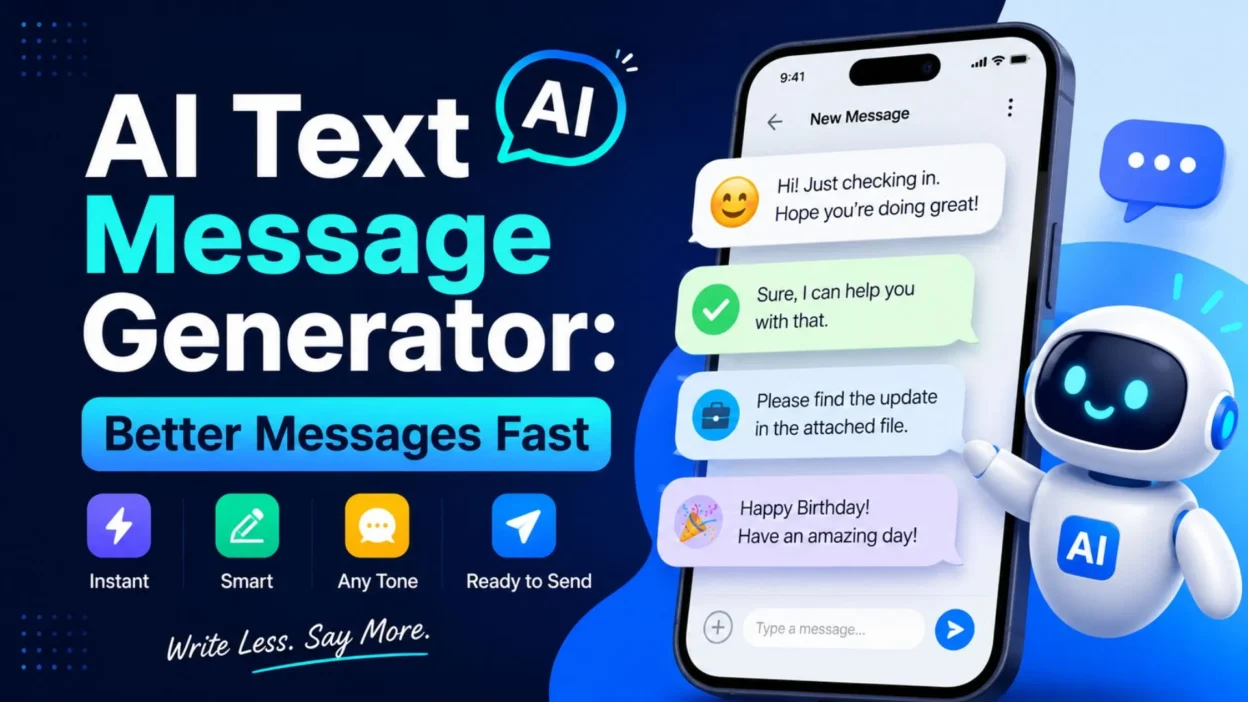
An AI text message generator can turn a blank chat box into a useful message in seconds. Whether you need a friendly reply, a quick reminder, a funny text, or a professional message, AI can help you find the right words.
No more staring at the screen thinking, “What do I even say?” 😄
This guide explains practical ways to use AI for better texts while keeping your messages natural, clear, friendly, and personal.
1. What Is an AI Text Message Generator?
An AI text message generator uses artificial intelligence to help create written messages from a simple request.
- Creates messages from short prompts
- Suggests different writing styles
- Helps when you cannot find the right words
- Can make messages shorter
- Can make messages clearer
- Can make messages more friendly
- Can suggest casual replies
- Can help with professional texts
- Can create simple reminders
- Can rewrite awkward sentences
- Can provide several message ideas
- Can adjust the tone
- Can remove unnecessary words
- Can fix basic grammar
- Can make texts easier to understand
The best results usually come when you give the AI clear information about your goal.
2. Create Friendly Everyday Messages
Sometimes a simple message feels harder to write than a long email.
- “Hey! How is your day going?”
- “Hope everything is going well!”
- “Just checking in. How are you?”
- “Have a great day!”
- “Thanks for your help!”
- “I really appreciate it.”
- “Let me know when you are free.”
- “Sounds good to me!”
- “That works perfectly.”
- “No worries at all.”
- “Thanks for letting me know.”
- “I will get back to you soon.”
- “Hope you have a relaxing evening.”
- “Talk to you later!”
- “Take care and have a good one!”
A simple message often works best. You do not need five paragraphs to say hello.
3. Write Better Replies
Getting a message is easy. Knowing how to reply is sometimes the tricky part.
- Ask AI for three reply options
- Choose a tone before generating
- Mention the main point
- Keep your reply natural
- Avoid unnecessary details
- Use short sentences
- Add personality when appropriate
- Match the other person’s tone
- Keep professional replies polite
- Use humor only when it fits
- Ask for a shorter version
- Ask for a warmer version
- Request a direct answer
- Remove repeated phrases
- Read the final message before sending
An AI text message generator can give you a starting point, but your final message should still sound like you.
4. Make Messages Shorter
Long texts can lose attention quickly.
- Remove repeated ideas
- Delete unnecessary introductions
- Keep the main point
- Use simple words
- Turn long sentences into short ones
- Remove filler phrases
- Keep important details
- Ask for a 20-word version
- Request a one-line reply
- Use bullet points when useful
- Avoid repeating names
- Remove unnecessary explanations
- Keep dates clear
- Keep times clear
- End with a simple action
Short does not mean cold. A clear message can still feel warm.
5. Make Messages More Friendly
Sometimes a message is correct but sounds a little robotic.
- Add a friendly opening
- Use conversational language
- Avoid overly formal phrases
- Add “please” when needed
- Use “thanks” naturally
- Keep the tone positive
- Avoid demanding words
- Add a light emoji when suitable
- Use the person’s name when appropriate
- Ask a simple question
- Show appreciation
- Avoid sounding rushed
- Keep sentences natural
- Use everyday vocabulary
- Read the message aloud before sending
The goal is not to sound like a robot that recently discovered a dictionary. 🤖
6. Generate Funny Family-Friendly Texts
An AI text message generator can also help create clean humor for everyday conversations.
- “My brain is loading. Please try again later.”
- “I planned to be productive. My sofa had other plans.”
- “Today needs a restart button.”
- “I am not late. I am dramatically on time.”
- “My to-do list is judging me.”
- “Coffee is not a solution, but it is a good beginning.”
- “I have officially run out of clever replies.”
- “My schedule and I are currently negotiating.”
- “Today has too many tabs open.”
- “I need a weekend for my weekend.”
- “My motivation took a tiny vacation.”
- “I am busy doing absolutely important things.”
- “This message contains zero boring energy.”
- “Mission today: survive the inbox.”
- “Achievement unlocked: replied to a message.”
Clean humor works best when everyone can enjoy it.
7. Create Professional Text Messages
Work messages should be polite, clear, and easy to understand.
- “Hello, I wanted to follow up on this.”
- “Could you please confirm the details?”
- “Thank you for the update.”
- “I will review this and respond shortly.”
- “Please let me know if anything changes.”
- “Could we schedule a quick call?”
- “I appreciate your time.”
- “The requested information is ready.”
- “Please confirm when convenient.”
- “I have received your message.”
- “I will send the update shortly.”
- “Thank you for your patience.”
- “Could you share the latest version?”
- “Please let me know your preferred time.”
- “I look forward to your response.”
Keep professional texts focused. Nobody wants a novel in their notification bar.
8. Create Appointment Reminders
Reminders should provide the information people actually need.
- Mention the appointment date
- Include the time
- Add the location if needed
- Mention online meeting details
- Keep the reminder brief
- Use a friendly tone
- Ask for confirmation
- Mention required documents
- Include preparation details
- Avoid confusing abbreviations
- Use the correct time zone
- State changes clearly
- Mention the contact person
- Add a useful follow-up instruction
- Keep the final version easy to scan
A good reminder answers the basic questions before the reader has to ask them.
9. Write Thank-You Messages
A short thank-you message can make someone’s day.
- “Thanks so much for your help!”
- “I really appreciate your support.”
- “Thank you for taking the time.”
- “That was very helpful.”
- “Thanks for making this easier.”
- “I appreciate you getting back to me.”
- “Thank you for the quick response.”
- “Your help means a lot.”
- “Thanks for keeping me updated.”
- “I am grateful for your time.”
- “Thanks for explaining everything.”
- “I appreciate the effort.”
- “Thank you for being so helpful.”
- “Thanks again for your support.”
- “I really appreciate it!”
Specific thanks usually feel more genuine than a generic “thanks.”
10. Generate Apology Messages
A good apology should be honest and simple.
- Acknowledge the mistake
- Avoid making excuses
- Keep the tone respectful
- Say what you will do next
- Avoid blaming someone else
- Keep the message sincere
- Do not over-explain
- Ask how you can fix it
- Take responsibility
- Avoid repeating the same apology
- Use calm language
- Be clear about the situation
- Show that you understand
- Offer a practical solution
- End respectfully
The goal is to repair communication, not win an argument.
11. Create Reminder Messages
Reminders are useful for school, work, projects, and everyday tasks.
- “Just a quick reminder about tomorrow.”
- “Friendly reminder: the meeting starts at 10.”
- “Please remember to send the document.”
- “Just checking that this is still on track.”
- “Reminder: the deadline is Friday.”
- “Please confirm when you have a moment.”
- “Quick reminder about our appointment.”
- “Don’t forget to check the updated file.”
- “Just wanted to remind you about the task.”
- “The event starts at 6 PM.”
- “Please bring the requested information.”
- “Remember to reply when convenient.”
- “A quick reminder before the weekend.”
- “Please check this when you get a chance.”
- “Thanks for taking care of it!”
A friendly reminder feels much better than a message that sounds like a command.
12. Create Customer Service Messages
Businesses can use AI to draft simple customer messages.
- Thank customers for contacting you
- Confirm that a request was received
- Provide basic updates
- Ask for missing information
- Explain the next step
- Keep the language polite
- Avoid unnecessary jargon
- Offer clear instructions
- Confirm important details
- Apologize when appropriate
- Thank customers for patience
- Ask whether more help is needed
- Keep responses consistent
- Personalize the message
- Review every message before sending
AI can help with drafting, but important customer information should always be checked by a person.
13. Create Follow-Up Messages
Following up can feel awkward. A clear message makes it easier.
- “Just following up on my previous message.”
- “I wanted to check whether you had a chance to review it.”
- “Please let me know if you need anything else.”
- “I am checking in regarding the update.”
- “Have you had a chance to look at this?”
- “Just wanted to see if there is any news.”
- “I would appreciate an update when convenient.”
- “Please let me know your thoughts.”
- “Checking in before the deadline.”
- “I wanted to make sure this did not get missed.”
- “Happy to provide more details.”
- “Let me know if the timing still works.”
- “I look forward to hearing from you.”
- “Thanks again for your time.”
- “Please reply whenever convenient.”
Good follow-ups are polite without sounding pushy.
14. Generate Conversation Starters
Starting a conversation does not have to be complicated.
- “How has your week been?”
- “What are you working on today?”
- “Any interesting plans for the weekend?”
- “What has been the highlight of your day?”
- “What is something fun you learned recently?”
- “What kind of music have you been enjoying?”
- “What is your favorite way to relax?”
- “Have you discovered anything interesting lately?”
- “What are you looking forward to?”
- “What is one thing that made you smile today?”
- “What is your favorite hobby?”
- “What is something you want to learn?”
- “What was the best part of your day?”
- “Any good recommendations lately?”
- “What is keeping you busy these days?”
The best conversation starter is one that gives the other person something easy to answer.
15. Create Event Invitations
Invitations should make the key information obvious.
- Start with a friendly invitation
- Mention the event
- Include the date
- Include the time
- Add the location
- Mention online details if needed
- Explain what guests should bring
- Ask for confirmation
- Keep the wording welcoming
- Avoid unnecessary details
- Use a clear call to action
- Mention the expected duration
- Include contact information when appropriate
- Make the message easy to scan
- Proofread names and dates
A good invitation answers “what, when, and where” quickly.
16. Improve Awkward Messages
Sometimes the idea is fine, but the wording feels strange.
- Ask AI to make it natural
- Keep your original meaning
- Remove unnecessary repetition
- Replace complicated words
- Fix grammar
- Make the tone warmer
- Make the tone more professional
- Shorten the message
- Remove unnecessary apologies
- Make the request clearer
- Add a polite closing
- Keep important details
- Avoid exaggerated language
- Ask for two alternatives
- Pick the version that sounds most like you
Never let AI change the meaning of an important message without checking it.
17. Generate Multiple Message Styles
One message can have several useful versions.
- Friendly version
- Professional version
- Casual version
- Short version
- Warm version
- Direct version
- Polite version
- Cheerful version
- Simple version
- Formal version
- Funny version
- Encouraging version
- Confident version
- Neutral version
- One-line version
This is one of the most useful features of an AI text message generator because you can compare options before choosing one.
18. Use Better AI Prompts
The quality of your request can affect the quality of the generated message.
- Explain who the message is for
- Explain why you are sending it
- State the desired tone
- Mention the important details
- Give a word limit
- Ask for simple English
- Request several options
- Ask for a natural tone
- Ask the AI to avoid clichés
- Provide your original draft
- Explain what feels wrong
- Request a shorter version
- Request a more polite version
- Request a more casual version
- Ask the AI to preserve your meaning
For example, instead of saying “write a message,” try: “Write a short, friendly message asking my teammate to confirm tomorrow’s meeting time.”
19. Personalize AI-Generated Messages
AI gives you a draft. You give it personality.
- Add the person’s name
- Mention a shared context
- Include a specific detail
- Use your normal greeting
- Remove phrases you never use
- Add your usual sign-off
- Adjust the level of formality
- Keep your natural vocabulary
- Add a suitable emoji
- Remove unnecessary emojis
- Check every fact
- Make the message sound human
- Avoid copying blindly
- Read it before sending
- Edit anything that feels unnatural
Personalization is what turns an AI draft into your message.
20. Avoid Common AI Messaging Mistakes
AI can be helpful, but it is not perfect.
- Do not send every message without reading it
- Check names carefully
- Check dates carefully
- Check times carefully
- Verify important information
- Remove robotic phrases
- Avoid unnecessary length
- Do not share sensitive information
- Do not assume every suggestion is correct
- Match the message to the situation
- Check the tone
- Remove accidental repetition
- Avoid awkward expressions
- Keep private details private
- Use your own judgment
Think of AI as a writing assistant, not an automatic “send” button.
21. AI Text Message Generator Ideas for Daily Life
There are many simple situations where AI can save time.
- Morning reminders
- Meeting confirmations
- Project updates
- School-related messages
- Customer replies
- Thank-you texts
- Event invitations
- Follow-up messages
- Friendly greetings
- Short announcements
- Appointment reminders
- Schedule changes
- Simple apologies
- Conversation starters
- Quick status updates
The biggest benefit is often not fancy writing. It is saving a few minutes when you are stuck.
22. Best Practices for Using an AI Text Message Generator
A few simple habits can make your results much better.
- Start with a clear goal
- Give enough context
- Choose the right tone
- Keep the request specific
- Ask for short messages
- Request multiple options
- Review the result
- Personalize the final version
- Check names and facts
- Remove unnecessary words
- Protect private information
- Avoid sharing sensitive data
- Use simple language
- Make sure the message fits the audience
- Send only after reviewing it
The smartest approach is simple: AI drafts it, you decide it.
FAQs
What is an AI text message generator?
An AI text message generator is a tool that uses artificial intelligence to create or improve messages. You provide a situation or goal, and it suggests suitable wording.
Can an AI text message generator create professional messages?
Yes. You can ask for a professional, polite, concise, or formal style. It can help with work updates, reminders, customer messages, and other everyday communication.
Can I use AI to make a text message shorter?
Yes. You can paste your draft and ask the AI to shorten it while keeping the main meaning. You can also request a one-line version.
Should I send AI-generated messages without checking them?
It is better to review every message first. Check names, dates, facts, tone, and private information before sending.
How can I get better results from an AI text message generator?
Give clear context, explain the purpose, choose a tone, and mention the desired length. Then review and personalize the final result.
Conclusion
An AI text message generator can make everyday communication faster, easier, and less stressful. From friendly replies and professional updates to reminders, invitations, and clean jokes, AI can help you find the right words when your brain decides to take a coffee break. ☕😄
The key is to use AI as a helpful writing partner. Give it clear instructions, review the result, and add your own personality before sending.
If this guide helped you, save it, share it with someone who is always stuck on “What should I text?” and leave a comment with your favorite messaging tip.

Muhammad Shahroz is a passionate writer who creates helpful content about messages and word meanings. He is committed to providing clear, accurate, and easy-to-understand information on TextsMessagez.com.